
Dominican journalist Aníbal de Castro has detailed the economic, literary, and political evolution of Buenos Aires as President Javier Milei implements radical reforms.
De Castro explained that the Argentine capital is experiencing a new political atmosphere as Milei battles inflation and attempts to restore trust in the national currency.
According to De Castro, Milei has established a confrontational style of governance, using public allegations to challenge political opponents domestically and internationally, including Brazilian President Luiz Inácio Lula da Silva.
De Castro noted that supporters view Milei's approach as authentic, while critics consider it a form of unnecessary polarization.
Economic reforms and political climate
The Dominican writer highlighted that Buenos Aires continues to display the physical and social scars left by decades of inflation, devaluations, and economic frustration.
Beneath the magnificent facades of the capital, closed businesses, homeless residents, pensioners counting every peso, and families facing daily uncertainty remain widespread realities.
Despite these severe challenges, De Castro emphasized that Buenos Aires possesses an extraordinary capacity to outlast its rulers, having survived military regimes, populists, liberals, reformists, and regional warlords without losing its core identity.
Literary roots and Dominican connection
Reflecting on the cultural identity of Buenos Aires along the brown waters of the Río de la Plata, De Castro highlighted the enduring legacy of tango icon Carlos Gardel.
He also pointed to author Jorge Luis Borges, who once wrote that he judged Buenos Aires as eternal as water and air, describing a city where any street corner leads to a labyrinth, an infinite library, or a discussion on time.
De Castro emphasized the contribution of Dominican intellectual Pedro Henríquez Ureña, who died in a train carriage in Buenos Aires after making the city his second homeland.
Henríquez Ureña taught language and literature from university chairs, instilling an ethical legacy of rigor and civilized conversation that helped turn Buenos Aires into the intellectual capital of Spanish America during the twentieth century.
Borges wrote that Henríquez Ureña was one of the most memorable men he had known, while author Ernesto Sábato remembered him as one of the great teachers of his time.
Economic history and British influence
Recalling his university studies fifty years ago, De Castro cited historian James R. Scobie's book, Argentina: A City and a Nation, which argued that understanding Argentina requires examining Buenos Aires.
Scobie showed how economic maps revealed railway lines converging on the capital like spokes of a giant wheel, built by British engineers to connect the pampas to the port for exporting grain, meat, wool, and hides to Europe.
De Castro recalled his first visit to the capital when British influence remained visible through Harrods on Florida Street, the only branch the London department store opened outside the United Kingdom.
Monuments and urban architecture
The report detailed the urban grandeur of historic neighborhoods including Palermo, Belgrano, Recoleta, Barrio Norte, Retiro, and San Telmo, where street names honor national heroes, writers, scientists, and neighboring nations.
De Castro praised landmark structures such as the Teatro Colón, known for its acoustic perfection, and the Obelisk, built taller than Egyptian obelisks to commemorate the fourth centenary of the city's first foundation.
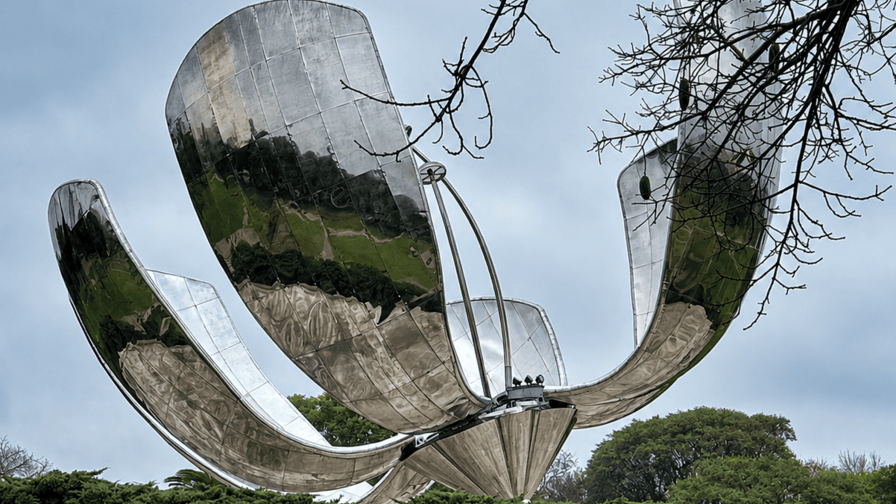
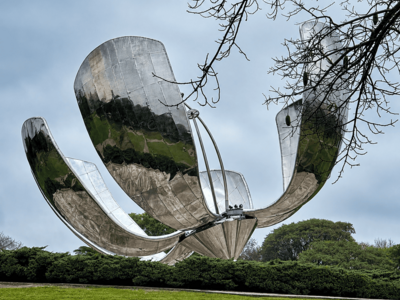
The capital also features the Floralis Genérica, a 23-metre stainless steel and aluminum flower sculpture in United Nations Square next to the Law Faculty, designed by architect Eduardo Catalano in 2002 to symbolize daily hope.
Travel links and persistent identity
De Castro noted that travel between Santo Domingo and the Río de la Plata has become easier thanks to daily non-stop flights and entry access for travelers holding valid United States visas.
He concluded that Buenos Aires remains an unfinished conversation between past and future, defined by vibrant cafes, independent bookstores, and the rhythm of the milonga.