

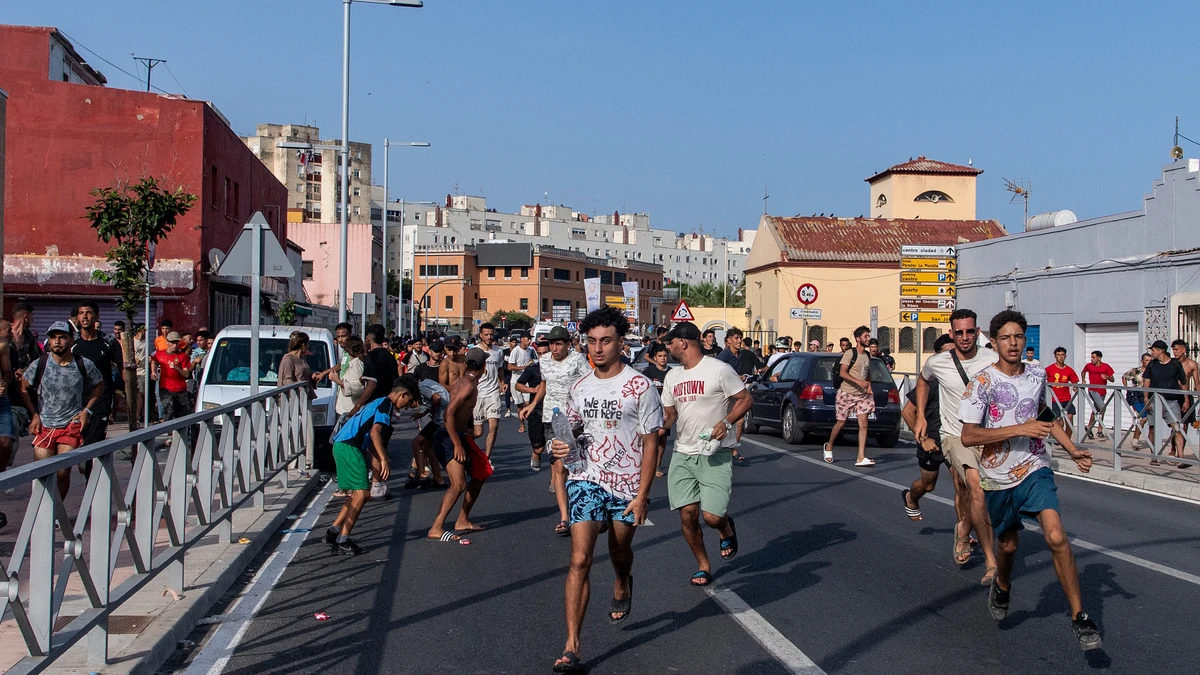
At least 67 bodies have been recovered from the coast of Ceuta after tens of thousands of migrants crossed from Morocco into the Spanish enclave, according to police sources.
Most of the dead are young people aged 20 to 35, and at least one is a woman. The Guardia Civil is still searching around the Tarajal breakwater, where most of the bodies have been found. The deaths bring to 99 the number of migrants who have died this year trying to reach Ceuta by swimming.
More than 50,000 people crossed into Ceuta within about 24 hours, according to the Interior Ministry. The Ceuta city government put the figure closer to 60,000.
Spain's security forces estimate that about 69,500 migrants have left Ceuta to return to Morocco over the last 30 hours. Police said that number may include people who had arrived in earlier days and some who crossed more than once. The government said more than 48,300 had returned on foot by Friday afternoon, at a rate of about 150 people per minute, watched by Spanish soldiers.
The Interior Ministry said the night passed without notable incidents and that entries from Morocco had stopped, while returns continued.
A dispute over Schengen
The mass crossing set off an international dispute. Italy temporarily suspended the Schengen free movement agreement with Spain, and several countries asked the European Union to expel Spain from the area. France increased its border agents fivefold, adding 334 police and gendarmes to its usual force.
Prime Minister Pedro Sanchez wrote to European institutions on Saturday to complain about what he called the unsupportive attitude of some countries, and asked for an urgent meeting of the interior ministers of the 27 member states. He sent the letter to European Council President Antonio Costa, European Commission President Ursula von der Leyen, and Ireland's prime minister as the rotating head of the EU Council.
Sanchez said Spain had regained control of the border in under 48 hours, provided humanitarian aid and returned almost all of those who crossed, yet several partners had chosen to attack Spain and even call for its temporary exclusion from Schengen. He rejected those calls, saying they were based on prejudice, fake news, ignorance or political interests.
The government said the integrity of Schengen was fully guaranteed. It said none of the roughly 50,000 people who entered could reach mainland Spain, because Ceuta and Melilla have a specific control system that requires people to identify themselves to the National Police before traveling by sea or air. Officials attributed part of the arrivals to disinformation spread by trafficking networks on social media and messaging apps, and dissociated the crisis from Spain's migrant regularization process.
Portugal said it did not see a need to suspend Spain from Schengen, though Foreign Minister Paulo Rangel called the situation extremely grave. He said people leaving Ceuta were subject to controls, but voiced concern that Spain's regularization policies could create a pull effect.
Sanchez frames a challenge to sovereignty
Sanchez described the entry of 60,000 people, using the Ceuta government's figure, as a violation of Spain's territorial integrity. He promised to use all the levers of the State to guarantee security in the city. He blamed human trafficking mafias and avoided naming Morocco as responsible.
Work began on Saturday to install a 500-meter pneumatic barrier at the Tarajal breakwater, a measure announced by Sanchez. The structure rises 30 to 70 centimeters above the water and extends up to a meter below it, with a line of buoys provided by the Navy.
Interior Minister Fernando Grande-Marlaska traveled to Ceuta to meet the government delegate, Miguel Angel Perez, and security commanders. Alberto Nunez Feijoo, leader of the opposition Popular Party, also went to the city and planned a statement with Ceuta president Juan Jesus Vivas near Tarajal beach.
In Morocco, authorities detained 70 people over violent incidents in Castillejos, the town next to the Tarajal crossing, where vehicles were set on fire. They are being investigated for attempted homicide, arson and damage to public and private property.
US President Donald Trump blamed Sanchez for the crisis, calling the situation a catastrophe during a cabinet meeting. Vice President JD Vance spoke of the consequences of mass migration. The State Department expressed solidarity with Spanish people but held Sanchez's government responsible.
Some migrants returned to Morocco to rest and try to cross again, saying a lack of food and water and the closure of shops had driven them back. Some young Moroccans said they headed to the border after seeing on social media that thousands were crossing, citing a lack of jobs and low wages at home.
The government also began a gradual reopening of the Beni Enzar crossing in Melilla, starting with vehicles from the annual Operacion Paso del Estrecho. In Ceuta, fairground workers began leaving after the city's Patron Saint festivities, planned for August 1 to 8, were cancelled.


