


A total solar eclipse swept across the Northern Hemisphere on Wednesday, August 12, 2026, turning day briefly into night for observers in parts of Greenland, Iceland, Spain and Portugal. It was the first total solar eclipse in more than two years, and the event was not visible, even partially, from Brazil.
A total solar eclipse happens when the Moon passes directly between the Earth and the Sun, completely blocking sunlight along a narrow strip of the planet's surface known as the path of totality.
Path of totality
Wednesday's band of totality began in northern Russia, near the Arctic, before crossing northeastern Greenland and western Iceland. It then swept across the North Atlantic to reach northern Spain and a small area of northeastern Portugal.
The eclipse began at 12:34pm Brasilia time, when the Moon started to cover the Sun. By 12:45pm, totality was approaching key viewing sites in Iceland, northern Spain and northeastern Portugal.
At 2:01pm Brasilia time, the first moments of total eclipse began over the Pronchishchev Peninsula in Russia, where totality was expected to start around 11:58pm local time, according to Time and Date. Images of the eclipse forming over Norway were captured by Time and Date and Reuters.
Weather conditions varied sharply along the route, from Greenland and Iceland to Spain. A storm moving in from the North Atlantic hit Iceland on the day, bringing rain and heavy cloud cover.

Totality reached Norway at 2:17pm Brasilia time and Iceland at 2:50pm.
Eclipse glasses rush in Paris
In the two days before the eclipse, long queues formed across France as people rushed to buy certified eclipse glasses ahead of the day's event.

In Paris, the eclipse reached 92.2% coverage at 8:17:22pm local time. Coverage peaked at different levels across France, ranging from 89.9% in Strasbourg to nearly 98% in Toulouse, according to NASA.
Spain's first total eclipse since 1905
At 2:06pm Brasilia time, thousands of people gathered at Arija, in northern Spain, to watch the total solar eclipse.

At 3:31pm Brasilia time, the Sun disappeared completely over Leon, in Spain, an exceptionally rare moment for the country, which had not experienced a total solar eclipse since 1905. Millions of people were expected to see the celestial spectacle across mainland Spain.
In Leon, totality began at 8:28pm local time and lasted about two minutes. Because the eclipse occurred close to sunset in Spain, the Sun's disappearance produced a sudden darkening of the sky in other parts of the country.
Totality ended at 3:47pm Brasilia time, with Spain's Balearic Islands the last place to experience the transformation of day into night.
How long totality lasted
The duration of totality varied along the path. Near Iceland, one of the points of greatest duration, the Sun remained completely covered for about 2 minutes and 18 seconds. Across most of the route, totality lasted less than two minutes.
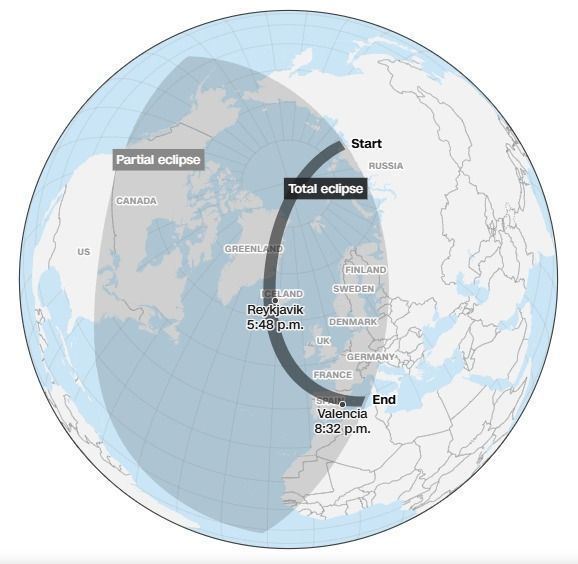
Scientists are able to calculate the path of an eclipse years, decades or even millennia in advance using powerful computer models and precise measurements.
The eclipse reached its global maximum at around 2:46pm Brasilia time, though that moment does not correspond to peak coverage in any single city, since the phenomenon moves across different regions of the planet as it unfolds. The European Space Agency also broadcast the event live.
Partial eclipse elsewhere
Outside the path of totality, people in other parts of Europe, in northern and western Africa, and in North America had the chance to see a partial eclipse, with varying levels of coverage of the Sun's disc.


