

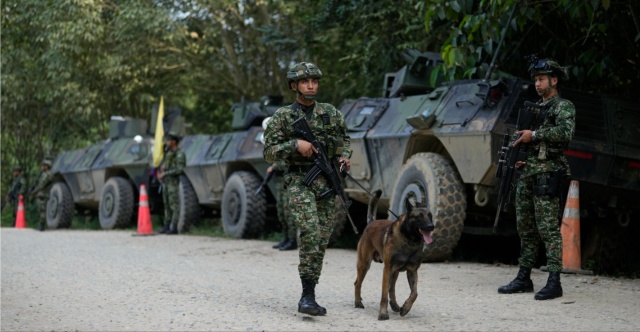
Three Colombian soldiers were killed and four injured on Monday when explosive devices detonated during an army patrol in central Colombia's rural Meta department.
The Colombian military said in an official statement that an infantry unit was struck in the field by the detonation of improvised explosive devices. Three soldiers died at the scene, while four wounded service members were evacuated to a local hospital for medical treatment.
The military identified the three soldiers who lost their lives in the attack as Elkin Quinto Mosquera, Oscar David Monterroza Suarez, and Jesus Adrian Ramirez Carrillo.
FARC Dissident Faction Blamed
Colombian authorities attributed the attack to a dissident faction of the former Revolutionary Armed Forces of Colombia, known as FARC. Officials named a rebel commander known as Calarca as the leader of the group responsible for planting the explosives.
The attack comes shortly after Colombian prosecutors reactivated arrest warrants against Calarca and several other rebel leaders in early September.
The FARC was a Marxist guerrilla movement that waged a 50-year war against the Colombian state before signing a landmark peace agreement with the government in 2016. While the majority of fighters demobilized under the accord, a significant faction rejected the peace terms and remained armed.
These dissident units continue to operate across rural Colombia, conducting attacks against security forces and competing armed groups. They finance their operations through drug trafficking, illegal mining, and extortion.
Government Operations in Meta
The bombing occurred more than a month after the Colombian military launched large-scale counter-narcotics operations targeting armed groups across the country.
The military campaign was ordered by President Abelardo de la Espriella, a hard-right political figure who assumed office in August. Upon taking power, de la Espriella ended peace negotiations that had been initiated by his predecessor, social democrat Gustavo Petro, with various insurgent factions.
Colombia remains the world's primary producer of cocaine, with armed groups competing for control of smuggling corridors and production regions such as Meta. The new administration has pledged an aggressive stance against drug trafficking syndicates and non-state armed groups operating within national territory.


