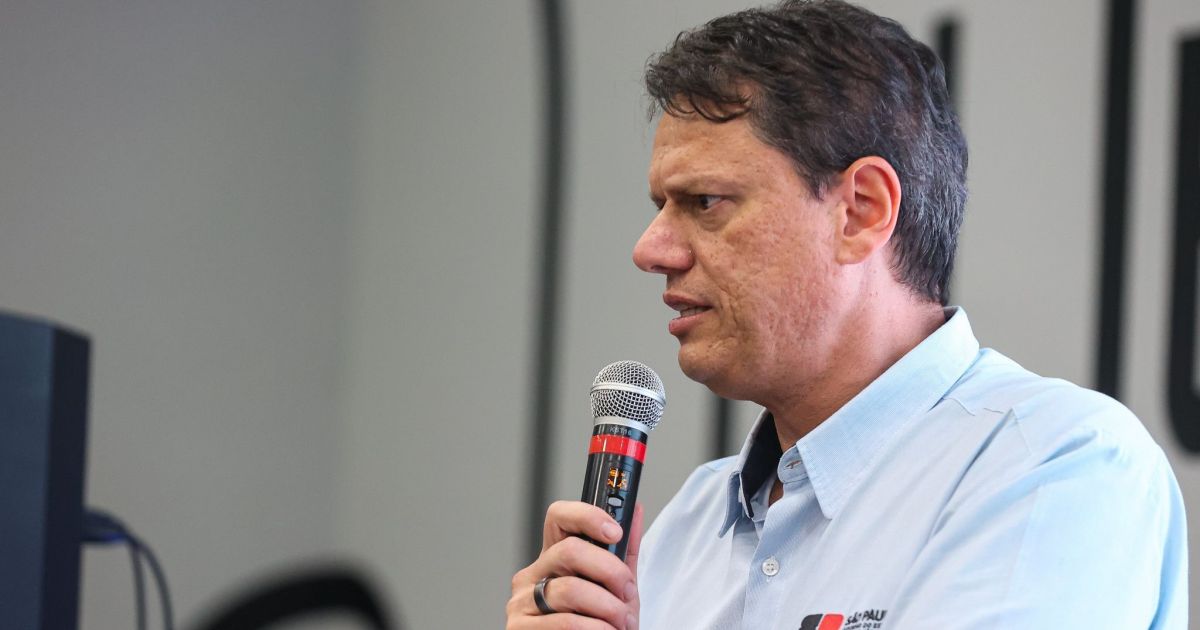
São Paulo Governor Tarcísio de Freitas, who is running for reelection with the Republicanos party, said on Tuesday that he supports the removal of Federal Police Director-General Andrei Rodrigues, a decision ordered by Supreme Federal Court Justice André Mendonça. Tarcísio also called on the Senate to act over suspicions involving fellow Justice Alexandre de Moraes.
Tarcísio said Mendonça had presented reasons for the removal and described the decision as the "path that has to be followed."
He said Mendonça had the reasons and had laid them out, speaking of illegal constraint that could not be permitted. He said that once authorities responsible for conducting investigations important to Brazil were illegally constrained, action had to be taken and a response had to be given. He said that response was given by Mendonça and endorsed by the majority of the Second Panel, which he called the path that had to be followed.
Federal Police leadership suspended
The Second Panel of the Supreme Federal Court formed a majority on Tuesday to uphold Mendonça's decision removing Rodrigues and the Federal Police's Director of Intelligence, Leandro Almada. The judgment was interrupted, however, by a request for further review from Justice Gilmar Mendes. Mendonça's injunction remains in effect in the meantime.
Mendonça has said he was the target of illegal monitoring by Federal Police intelligence, citing reports produced about his activities. His decision also ordered the Federal Police's internal affairs unit to investigate the circumstances surrounding the production of those documents. The Supreme Federal Court is Brazil's highest court, and the Second Panel is one of two five-justice panels that handle a portion of its caseload.
Pressure on the Senate
Tarcísio was also asked about allies who explicitly called for the impeachment of Moraes during Brazil's September 7 Independence Day demonstrations. He did not declare direct support for impeaching Moraes, but said both the Supreme Federal Court and the Senate needed to respond to the facts that had come to light.
He said what had been revealed was serious and needed an institutional response, adding that the barriers of what is legal could not be crossed and the barriers of the democratic rule of law could not be broken.
Tarcísio said it was up to the Supreme Federal Court to answer any doubts about whether the conduct of its members was compatible with serving as magistrates. He then turned his criticism directly to the Senate, Brazil's upper legislative chamber, which has formal oversight powers over the judiciary.
He said the Senate had a duty to act and a duty to oversee, and that it too was being called to account. He warned that if the Senate failed to act, the wider system of checks and balances would collapse, and would collapse in the worst possible way, worse than the ruin caused by omission itself. He said the Senate also had to be pressed to carry out its role.
A "credibility crisis"
Tarcísio said the Supreme Federal Court was going through a credibility crisis like it had never experienced before, calling it very serious and asking listeners to imagine a supreme court losing public trust.
He said trust in institutions needed to be restored, and that it would not be restored through silence or professional solidarity among judges, but through investigation and accountability.
Tarcísio also explained why he had taken a more moderate tone toward Moraes at this year's September 7 rally on Avenida Paulista, São Paulo's main avenue and a traditional site for political demonstrations, a shift that CNN Brasil had reported in advance the previous week. In 2025, Tarcísio had called Moraes a "dictator" at the same event.
He said the tone had been the right one for the moment Brazil was living through, and that the country was demanding a response, one that had to be institutional.
Mendonça as a symbol of "hope"
Asked whether André Mendonça could go through a process of political personalization similar to what allies attribute to Moraes, Tarcísio said Mendonça currently represents hope. He said there was widespread hope that things would work out and that state institutions would function properly again, and that on that front Mendonça represented that hope today.
He described Mendonça as very discreet, very firm, but also very wise, and referred as well to Supreme Federal Court President Edson Fachin. He said he prayed to God that Mendonça had that wisdom, and prayed that Fachin had it too, given that Fachin was leading the court through an extremely delicate situation and Brazil could not afford to lose its Supreme Court.
Tarcísio again argued that the crisis should be resolved through Brazil's own institutions. He said the country needed to get through the crisis, but that it had to happen the right way, through investigation, inquiry and accountability, concluding that no one is above the law.