
Royal Academy painter Solomon Joseph Solomon pioneered British tank camouflage and military deception during the First World War, applying fine art techniques of light and shadow to conceal armored vehicles and frontline troops. Thirty years after astonishing London gallery audiences with his mythological painting Ajax and Cassandra, Solomon adapted his mastery of illusion to hide British war machines on the battlefields of France.
Too old to join active combat units, Solomon enlisted as a private in the Artists Rifles before traveling to the Western Front in December 1915. He observed battlefield terrain firsthand and studied French military concealment methods, leading to his rapid promotion by General Douglas Haig to temporary lieutenant colonel.
Solomon was born in London on September 16, 1860, into a Jewish family deeply devoted to the arts. His sister, Lily Delissa Joseph, also achieved prominence as a painter. Solomon received his early artistic training at the Heatherley School of Fine Art in London, an independent institution founded in 1845, before advancing to the Royal Academy Schools and the Munich Academy.
He completed his studies in Paris under French academic master Alexandre Cabanel at the École des Beaux-Arts. Alongside Cabanel, Solomon drew stylistic inspiration from British classical painters Lord Frederic Leighton and Sir Lawrence Alma-Tadema, inheriting their preference for biblical and mythological themes. While Alma-Tadema set classical figures within serene marble surroundings and Roman baths, Solomon embraced dramatic Parisian techniques, featuring tense figures, violent foreshortening, and a raw sensuality that challenged Victorian moral standards.
Academic success and royal portraits
Solomon gained widespread recognition through his bold artistic choices. In 1902, he completed Psyche, a painting exhibited at the Royal Academy that became one of the period's most celebrated depictions of the classical goddess.
The canvas was sent to the Robert McDougall Art Gallery in Christchurch, New Zealand, in 1907. On the night of June 21, 1942, thieves cut Psyche from its display frame and stole the painting. The artwork was never recovered, leaving only the empty frame on display at the gallery.
Solomon's growing reputation earned him prominent commissions from the British Royal Family, who hired him to paint formal portraits of King George V, Queen Mary, and the Prince of Wales, who later briefly reigned as King Edward VIII. Solomon co-founded the New English Art Club in 1886 to exhibit alongside progressive artists, became a full Royal Academician, and served as president of the Royal Society of British Artists in 1919. In 1914, he authored an influential instructional manual titled The Practice of Oil Painting and Drawing.
First World War camouflage innovations
The outbreak of the First World War redirected Solomon's career. Writing articles for British newspapers, he argued that effective military camouflage depended entirely on precise color matching. He explained that painting a tank or position in colors unsuited to local soil did not hide the vehicle, but instead betrayed its location to enemy observers.
Determined to analyze real battle conditions, Solomon traveled to France in December 1915 to inspect the landscape palette and mud of the Western Front. He studied the operations of the French Section de Camouflage, the world's first dedicated military concealment unit, directed by painter Lucien-Victor Guirand de Scévola. Impressed by Solomon's technical insights, Commander-in-Chief General Douglas Haig appointed him temporary lieutenant colonel before the end of December 1915.
In March 1916, British forces constructed their first observation post disguised as a tree based on Solomon's designs. The structure featured an armored observation core wrapped in artificial bark and painted using trompe-l'œil techniques derived from fine art portraiture to blend seamlessly into surrounding trees.
Development of British tank camouflage
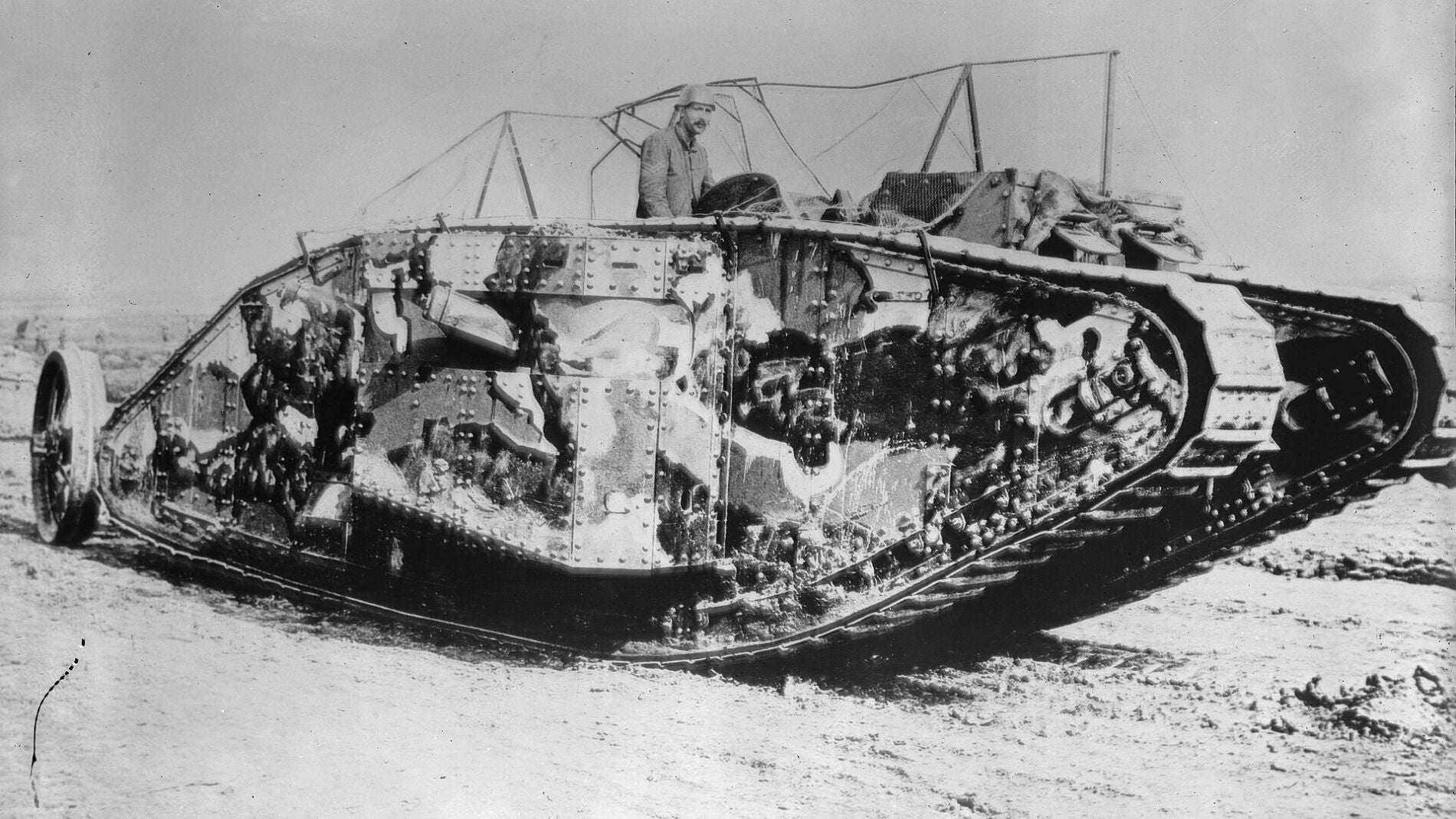
Solomon returned to England in May 1916 to design visual disguises for Britain's newly developed Mark I tanks, which were undergoing secret field trials near Thetford in Norfolk. He questioned early proposals to disguise tanks as trees, warning that the extreme height of such structures produced large, revealing shadows across open ground.
Working in England, Solomon created an initial four-color paint scheme intended for armored vehicles. However, when the tanks arrived at the front in France, the original paint scheme failed against the deep mud and natural tones of the battlefield. The vehicles were repainted on site, proving Solomon's assertion that military camouflage must adapt directly to local environment.
This setback led Solomon to champion lightweight camouflage nets capable of distorting vehicle outlines without adding rigid height. Although mass production of the netting did not begin until 1917, Solomon established a dedicated military camouflage school in Hyde Park in December 1916, which was later absorbed directly by the British Army.
Strategic warnings and modern legacy
In 1918, while examining Allied aerial reconnaissance photographs prior to the German Ludendorff Offensive, Solomon identified evidence that German forces were concealing an entire army under canvas covers and netting. British high command dismissed his warning. Solomon later defended his analysis of aerial camouflage in his 1920 book Strategic Camouflage.
Solomon's wartime netting techniques laid the groundwork for modern military pattern design. The earth-toned schemes developed for Mark I tanks in French mud evolved into the olive drab, forest green, and pine green camouflage used by modern armored units today.
Other British artists made similar wartime contributions, including marine painter Norman Wilkinson, who invented dazzle camouflage using bold geometric shapes to confuse U-boat torpedo rangefinders. Solomon's career demonstrated that the visual principles used to deceive the human eye on canvas were essential tools on the battlefield.