


A massive glacier collapse in the Himalayan mountain region has triggered a catastrophic wall of mud and water across Nepal and Tibet, killing more than 350 people and leaving over 1,300 missing.
Search and rescue operations are underway across affected districts, where three Portuguese citizens, including one man and two women, are among those unaccounted for following the surge.
Nepal, a landlocked South Asian nation located in the Himalayas, has seen severe destruction in Nuwakot district, where buildings have been surrounded by a vast sea of thick mud.
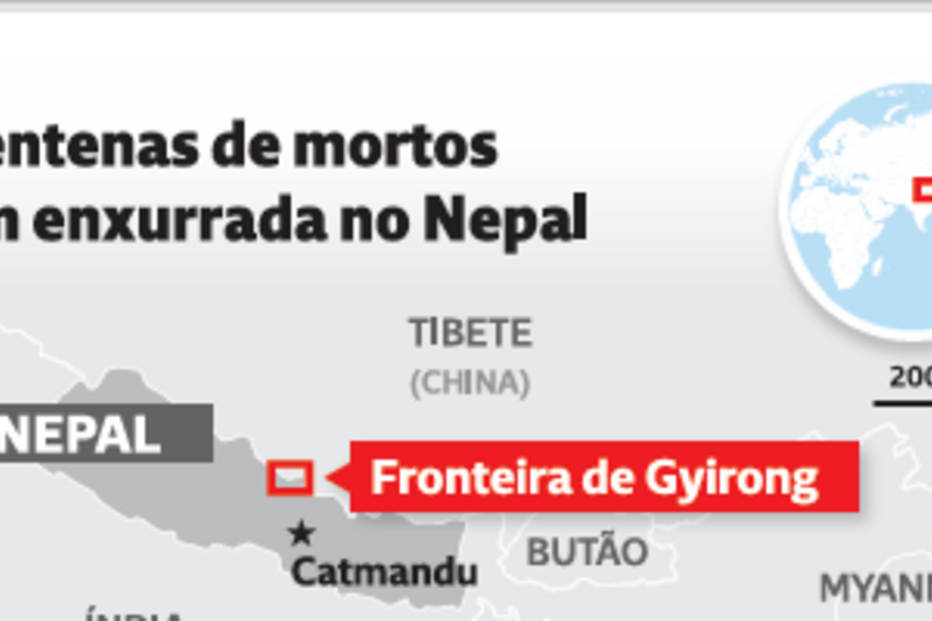
The disaster began when temperatures in the high mountains rose abruptly, causing large quantities of snow to melt rapidly within 24 hours. The sudden melting caused a glacier to collapse at an altitude of more than 5,000 meters, sending an avalanche of rock and ice crashing down into the Lhende Khola river.
The avalanche formed an unstable natural barrier along the riverbed, damming the water flow. Under intense hydraulic pressure, the natural dam suddenly gave way, releasing a torrent of water, mud, and rocks that swept across the landscape with the force of a tsunami.
Initial reports suggested the destruction had been caused by an earthquake after the United States Geological Survey recorded a magnitude 4.4 tremor in the border area between Nepal and Tibet. However, experts noted that the quake occurred at a shallow depth of about 10 kilometers below the surface and was not intense enough on its own to produce such devastation, leading officials to identify the high altitude glacier collapse as the true trigger.
Rescue operations across the border
Emergency crews comprising police officers, military personnel, scouts, rescue workers, and local volunteers have managed to rescue more than 500 people alive from the debris. The Nepalese Army alone successfully rescued 350 survivors from flooded zones.
Rescuers described striking scenes of survivors pulled from the wreckage with their bodies completely covered in mud. Authorities emphasized that current casualty figures remain provisional because disaster response teams have been unable to reach remote mountain areas due to difficult access.
The Himalayan mountain range contains numerous glaciers and high altitude river systems. Glacial lake outburst floods and rapid debris flows occur when natural ice or rock dams holding back meltwater fail, creating sudden downriver inundations.
Threat of secondary mudslides
Rescue operations are racing against time as emergency situation reports warn of ongoing dangers along the river valley. Official emergency assessments stated that the lake formed behind the river barrier following the avalanche has not yet fully receded, leaving the threat of another mudslide high.
A natural disaster specialist warned that the region could face potential second and third waves of flooding as unstable debris continues to choke local waterways.
Weather forecasts for the coming days predict additional periods of rainfall across the region, which could further destabilize natural barriers formed by glacier debris along the rivers and trigger new flash floods and mudslides.


