

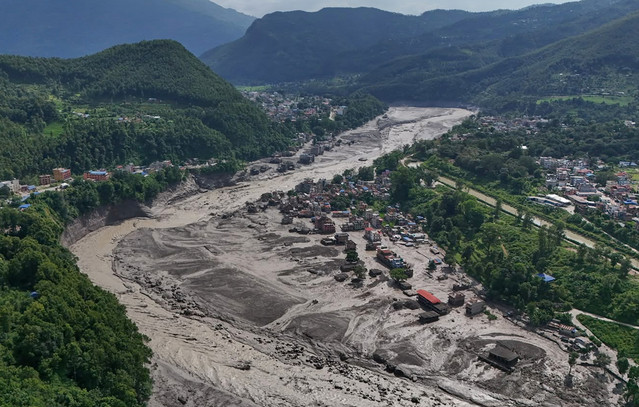
More than 1,000 people have died and over 4,400 remain missing after catastrophic floods and landslides struck Nepal and Tibet.
Official casualty figures confirm that 987 people lost their lives in Nepal, while another 13 fatalities were recorded across the border in China. A total of 4,462 people are listed as missing, including 3,916 in Nepal and 546 in the Tibet region of China.
Rescue operations in Nepal achieved a major breakthrough after emergency workers successfully rescued nearly 300 workers who had been trapped in the ruins of Himalayan hydroelectric power plants for almost a week following the disaster.
Emergency teams constructed temporary bridges across swollen rivers and damaged terrain to reach isolated mountain areas that had been completely cut off by the destruction.
Nepal Prime Minister Balendra Shah announced on Monday that more than 11,000 people have been rescued across the country so far as search and recovery efforts continue.
Rescue operations at hydroelectric power plants
Approximately 600 workers remain trapped inside damaged hydroelectric power stations across Nepal, where emergency rescue teams are now focusing their main efforts.
Shah specified that 279 workers have been pulled safely from the affected power plants so far. Nepalese authorities estimate that nearly 1,000 workers in total were initially trapped inside the damaged facilities when the land collapsed.
Crews have successfully restored the road network leading to Nuwakot, one of the districts hardest hit by the disaster. Reopening the roads has allowed search and rescue teams to enter the area and distribute essential emergency supplies to residents.
Electricity and telecommunications services have also been restored in select areas, providing crucial communications links for ongoing emergency management.
Neighboring countries India and China are actively providing assistance to support the Nepalese rescue operations. Their efforts include deploying technical equipment and setting up temporary bridges to reconnect isolated communities.
Economic impact and international disaster aid
Nepal has received more than 42 million dollars in international disaster relief aid since the catastrophe occurred. The Nepalese government stated that it expects total foreign aid contributions to increase as international assistance arrives.
Government officials in Kathmandu warned that the total cost of rebuilding damaged infrastructure and homes could reach several billion dollars. The massive financial burden comes at a time when the economy of Nepal is already suffering under severe strain.
In a social media message posted on Monday, Prime Minister Shah expressed solidarity with disaster victims, noting that thousands of citizens have lost their homes, families, loved ones and property in the catastrophe.
Shah stated that the government recognizes the immense suffering faced by the population. He added that the primary task moving forward is to support affected citizens through this severe trial and assist them in returning to normal life.
Climate change threats in the Himalayan region
Shah warned that the deadly landslides highlight the escalating environmental hazards threatening the high-altitude region. He stated that the disaster demonstrates that the risks facing the Himalayan zone are increasing as a direct consequence of climate change.
The prime minister urged regional leaders and the global community to take immediate action, stating that the region must remain on high alert. He added that the time has come to urgently present the issue of climate-induced disasters before international forums.
Nepal has experienced a major boom in hydroelectric infrastructure in recent years. The landlocked nation has sought to harness the fast-flowing water resources of the Himalayas to resolve chronic domestic electricity shortages and export surplus power to neighboring India.
Nepal is a predominantly agricultural nation located in South Asia, sandwiched between India and China, with a population of approximately 30 million people.
Despite contributing a negligible fraction of the global carbon emissions that drive global warming, Nepal ranks among the countries most severely impacted by extreme weather events and climate instability.
The vast glaciers of the Himalayas and the Hindu Kush mountain ranges function as critical water towers for Asia. They supply essential water supplies to hundreds of millions of people living in mountain zones, river basins and agricultural plains across South and Southeast Asia.
Commenting on the disaster over the weekend, United Nations climate chief Simon Stiell warned that climate change is generating human tragedies of this scale, according to reporting by the Athens-Macedonian News Agency.


