

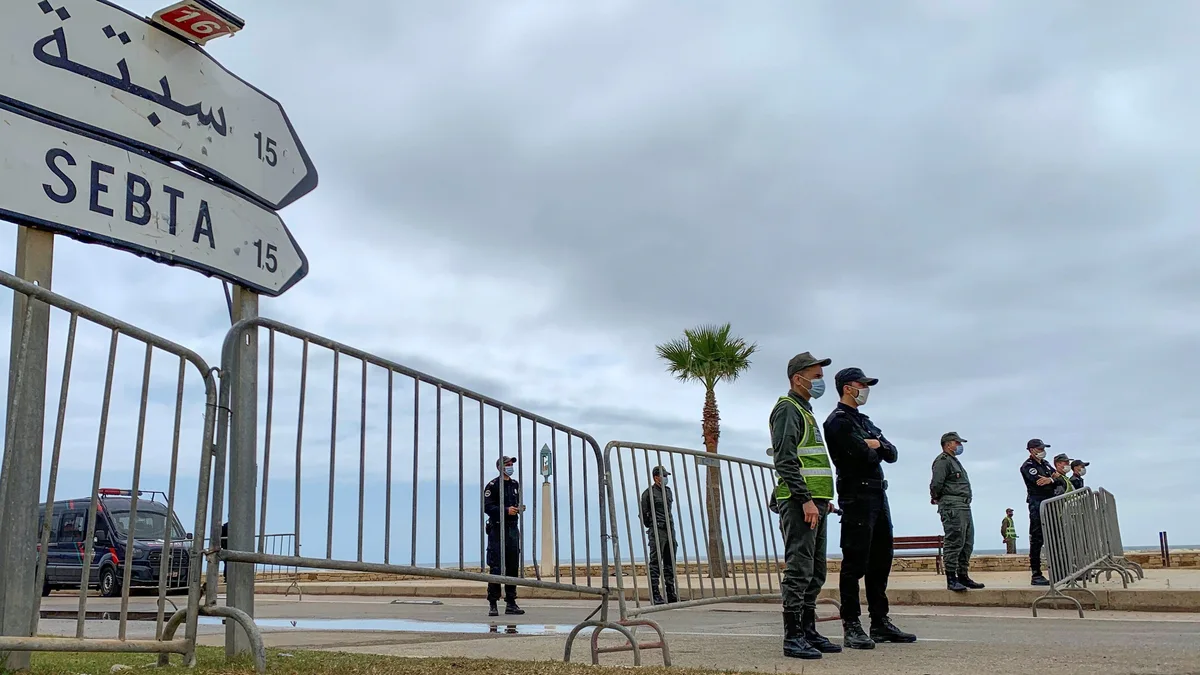
The mass irregular crossing of up to 60,000 people into the Spanish enclave of Ceuta over eleven days, culminating on July 30, has shattered what the Spanish government had long called the best bilateral relationship with Morocco in history, according to specialists and observers cited in Spanish reporting.
Spanish security sources confirmed to the publication that Moroccan police and gendarmerie withdrew from the border perimeter on the morning of July 30, a claim corroborated by video material shared on social media by participants in the crossing.
The spike in crossings had been building for more than ten days before the main surge. Around one thousand migrants swam into Ceuta in the week ending the previous Sunday, Spanish security sources noted, pointing to what they described as a deliberate slowness by Moroccan authorities in reporting the mass movement of young people from across Morocco toward the border town of Castillejos in the hours before the main assault on the Tarajal fence.
Competing Explanations
Analysts offered several possible factors behind the Moroccan security lapse. One was the effect of a July 8 Supreme Court ruling that bars the application of summary border-rejection procedures to migrants intercepted at sea while attempting to swim into Ceuta and Melilla. Another was reported displeasure in Rabat over Prime Minister Pedro Sanchez's visit to Algiers, given Algeria's status as Morocco's arch-rival.
Neither explanation, specialists said, was sufficient to account fully for the scale of events, which they said could only have occurred because of the inaction of Moroccan security forces.
One theory circulating in Spanish security circles was that many Moroccan personnel were redeployed to the nearby town of Rincon, where King Mohammed VI was presiding over an official reception to mark the 27th anniversary of his accession to the throne on the same day.
A Civil Guard officer deployed to the area said that after Moroccan forces allowed people to cross during the morning and effectively disappeared from the fence line, by night they had returned to their usual posture.
Official Responses
Interior Minister Fernando Grande-Marlaska and Prime Minister Sanchez both attributed the land incursion solely to criminal smuggling networks, with Sanchez speaking in Ceuta on Friday. Spanish security sources said those statements suggested the government had no intention of altering its approach to relations with Morocco.
Angel Llorente, who served as Spain's first judicial liaison with Morocco and as legal cooperation adviser at the Spanish Embassy in Rabat from 2005 to 2010, said Moroccan border police do not act unilaterally in situations like this, and that if such an influx occurred it was because officers had instructions to look the other way. Llorente said he had no grounds for optimism in this case.
Carlos Echeverria, president of the Ceuta and Melilla Observatory and a professor of international relations at UNED, said the events did not reflect a sudden outburst as in May 2021. He described what he called an extreme Moroccan ambition in relation to Spain, arguing that the Moroccan state was behind the crossing either by facilitating it or by turning a blind eye, and that Spain had not developed any strategy to counter that ambition in recent years.
Morocco's Position
Moroccan sources offered a sharply different reading. With no formal government statement, the limited official communication came through Moroccan sources speaking to the Efe news agency, who stressed cooperation with Spain and announced a mechanism to accelerate the return of those who had crossed irregularly. Moroccan official sources also blamed criminal networks for exploiting the Supreme Court ruling to convince young people that entry into Ceuta had become easier.
Moroccan sources consulted by the publication acknowledged that Rabat was displeased by photographs of Sanchez with Algerian President Abdelmajid Tebboune, and that a proposed law to grant Spanish nationality to people born in Western Sahara under Spanish administration and their descendants was unwelcome. However, those same sources denied any fundamental disagreement with the Sanchez government comparable to the rift of May 2021, and said the events were not the result of a premeditated operation.
One Moroccan source acknowledged that much of what Morocco had built in its relationship with Spain had been demolished in the space of a few hours, describing the scenes at the border, including dozens of deaths among those crossing, as very damaging to Morocco's international image, however partial justifications might exist.
By the time of publication, more than half of those who crossed had been returned, with Moroccan cooperation having continued through the crisis.


