


American company Marathon Fusion has announced successful tests of a plasma centrifuge capable of separating hydrogen and lithium isotopes for nuclear fusion reactors.
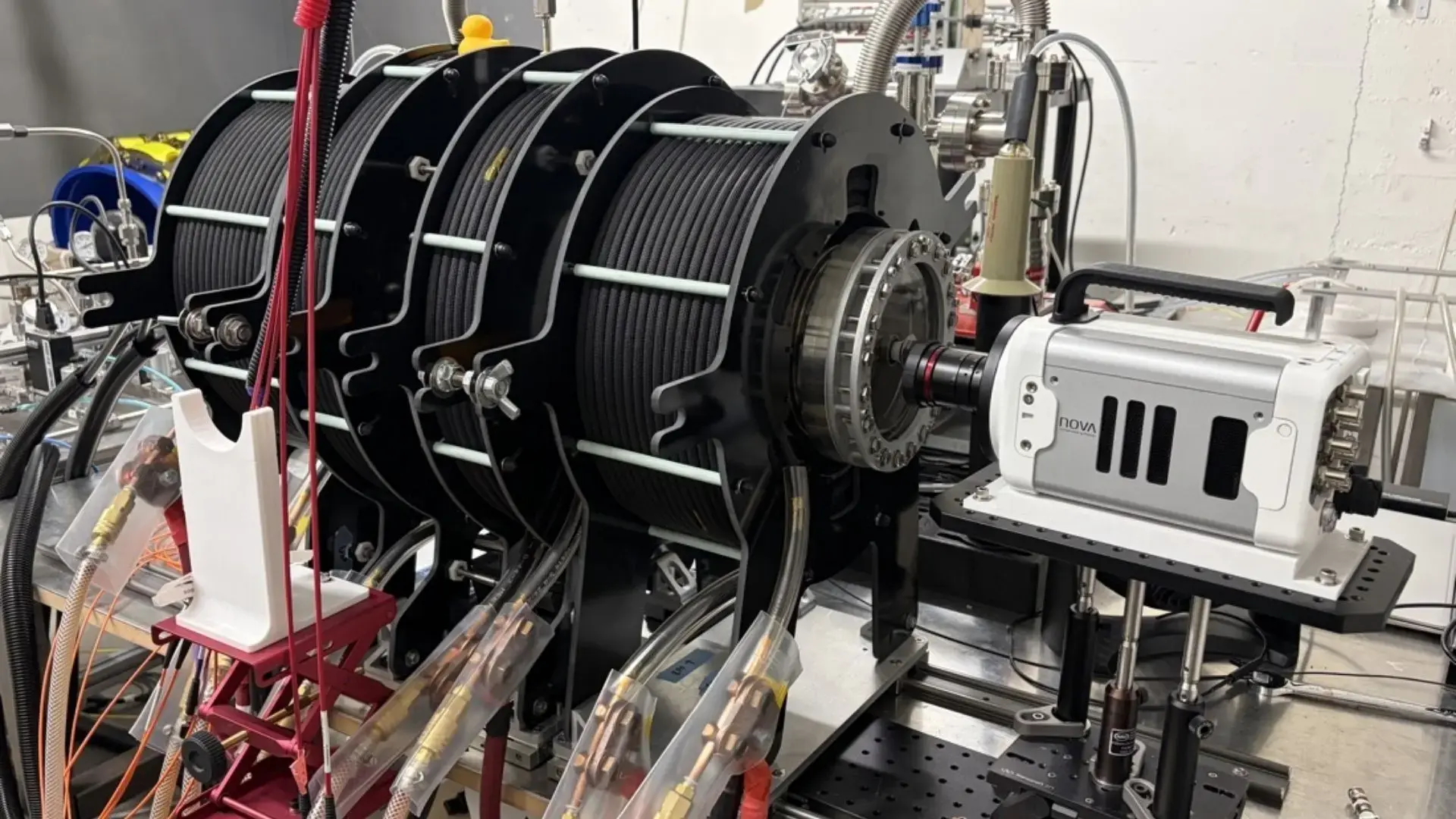
The developer said the single technology aims to solve two major operational challenges for future fusion power plants: recycling unburned fuel back into the reactor core and producing enriched lithium to generate new tritium fuel.
During a fusion reaction, only a portion of the injected deuterium and tritium is consumed. The remaining tritium must be separated quickly from helium ash and other reaction impurities so it can be returned to the fuel cycle.
Tritium is a radioactive isotope of hydrogen with a half-life of roughly twelve years. The company noted that keeping the quantity of radioactive tritium stored simultaneously at a power station as low as possible lowers safety requirements and reduces operational expenses.
A second major challenge facing fusion energy is the near complete absence of natural tritium reserves. Commercial fusion power plants must produce their own tritium on site by bombarding lithium with neutrons, a process that requires lithium enriched with the isotope lithium-6.
Supersonic plasma separation
Instead of relying on traditional mechanical centrifuges, Marathon Fusion employs electric and magnetic fields to achieve isotope separation. These fields accelerate a partially ionized gas to supersonic speeds, causing heavier isotopes to drift outward toward the container walls while lighter isotopes concentrate near the center.
If integrated directly into the reaction product exhaust line, the plasma centrifuge can isolate deuterium and tritium from helium before subsequent purification steps occur. The company estimated that this configuration could potentially reduce the volume of fuel processing equipment by more than 90% while noticeably decreasing the amount of tritium held on site at any given time.
Mercury free isotope enrichment
The company reported that the same plasma principle proved effective for separating lithium isotopes. Unlike conventional chemical enrichment methods that rely on toxic mercury, the plasma approach is a completely dry process that eliminates chemical hazards.
The development, reported by Interesting Engineering, offers a path toward simplifying the complex fuel cycles and regulatory demands of future commercial fusion power stations.


