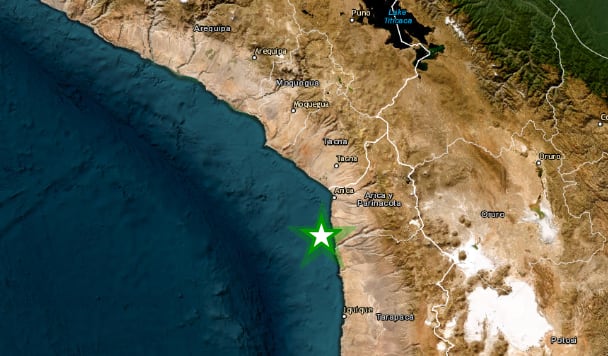
A magnitude 4.4 earthquake struck the southern Peruvian region of Tacna on the night of Friday, November 27, 2026, according to a seismic report from the Instituto Geofísico del Perú (IGP).
The quake was centred 108 kilometres south of Tacna province, in the department of Tacna, the IGP said. It struck at 9:55:34 p.m. local time at a depth of 68 kilometres.
The agency recorded an intensity of II-III on the scale used in Tacna, meaning the shaking was felt by residents in the area. The epicentre was located at latitude -18.95 and longitude -70.52, according to the report, which was issued under the code IGP/CENSIS/RS 2026-0836 by Peru's National Seismological Center.
Peru's Civil Defense authorities and the National Emergency Operations Center (COEN) said they were keeping constant watch to assess any possible secondary effects. As of the report, no injuries or material damage had been recorded.
Peru sits along the Pacific Ring of Fire, where the Nazca tectonic plate subducts beneath the South American plate, making the country one of the most seismically active in the world. The IGP continuously monitors and reports earthquakes across the country as part of its disaster-preparedness efforts.
What to do during an earthquake
Authorities recommend staying calm during a tremor, moving away from windows and objects that could fall, and moving to previously identified safe areas.
They also advise keeping an emergency backpack ready, stocked with basic supplies, documents, water and non-perishable food.
What an emergency backpack should contain
Civil Defense guidance lists several essential items for the first hours after a larger disaster. These include bottled water and non-perishable food that can be eaten easily, along with a flashlight, extra batteries, a portable radio, a whistle and a phone charger.
The list also calls for a first aid kit and regular medications, personal hygiene items, face masks, a change of clothes and warm clothing. Officials further recommend keeping small denomination cash, copies of important documents protected from moisture, a list of family and emergency phone numbers, spare keys, sturdy bags, work gloves and multi-purpose adhesive tape.
Civil Defense and COEN said monitoring would continue in the aftermath of Friday's quake to track any further seismic activity or effects.
What happens next
Civil Defense and the National Emergency Operations Center (COEN) said they would continue monitoring for any secondary effects from the quake.
Test yourself
What magnitude was the earthquake that struck Tacna?
How deep was the earthquake, according to the IGP?
Which agency issued the seismic report on the earthquake?
Where it happened
Tacna, Peru