
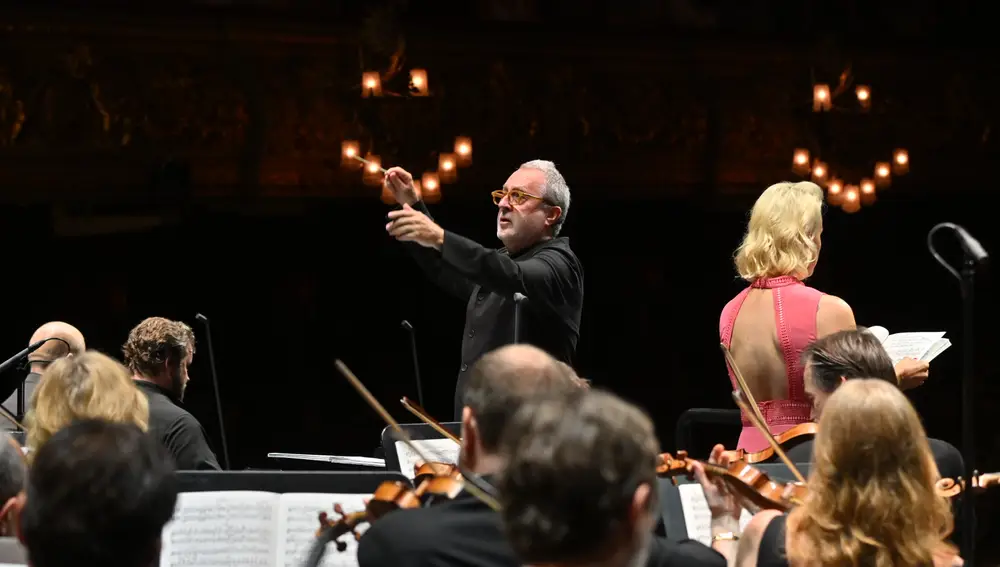
Conductor Josep Pons ended his 14-year tenure as music director of the Gran Teatre del Liceu in Barcelona on July 24. He conducted a sold-out performance of Gustav Mahler's Symphony No. 8, known as the Symphony of a Thousand, which brought an 11-minute standing ovation.
The concert concluded the Mahler Universe project that Pons launched at the Barcelona opera house. A few days before the final symphonic concert, Pons also ended his opera performances at the venue by conducting Giuseppe Verdi's last opera, Falstaff.
Although Pons has stepped down from his official post, his connection to the institution continues. The Liceu has dedicated a commemorative exhibition to his work and named him Honorary Music Director, while his immediate future will be with the Deutsche Radio Philharmonie.
Farewell performance and honours
Pons said he was deeply grateful for the 11-minute ovation and felt honored by the reception. He noted that nobody is a prophet in their own land, viewing the applause as confirmation that his assigned work was completed satisfactorily.
He thanked the orchestra and his collaborators for walking the path together, adding that the transformation would have been impossible without them. He also thanked the theater for providing the time and resources needed to rebuild, despite facing two major financial crises during his tenure.
Pons explained that he chose Mahler's Eighth Symphony as a statement of principles for his final concert. While Mahler's other symphonies explore internal fears and personal concerns, Pons noted that the Eighth focuses on divine and human love.
The piece references Mahler's wife Alma, to whom it is dedicated, as well as his mother Mary, in what Pons called a Freudian blend. It also incorporates Johann Wolfgang von Goethe's Faust, depicting a journey of self-improvement toward the Mater Gloriosa and the eternal feminine.
Pons described the monumental work as a symphonic thesis and an ultimate test for any orchestra and choir. To perform the piece, the Liceu Choir joined forces with the National Choir of Spain, the Polifònica de Puig-reig, and the Cor Vivaldi Petits Cantors de Catalunya, assembling nearly 300 singers on stage.
Rebuilding the Liceu Orchestra
When Pons arrived at the Liceu, the orchestra was severely weakened by economic crisis and suffered from numerous vacancies. He set out with two guiding goals: to give the orchestra visibility and centrality within the institution.
Pons focused on building a cohesive ensemble rather than relying solely on individual soloists. He worked to establish a distinct sound for different composers, including Wolfgang Amadeus Mozart, Franz Schubert, Giuseppe Verdi, and Richard Wagner.
During his 14 years, the orchestra underwent major expansion by filling 40 new positions. Pons expressed great pride in attracting top musicians aged 20 to 26, creating a young and mature generation eager to join the ensemble.
He noted that while the Liceu had always featured world-class singers and staging, the orchestra in the pit had previously been neglected. He expressed deep satisfaction that the pit now holds a first-rate international orchestra.
Sowing seeds for future growth
Pons stated that he achieved nearly 100 percent of the goals he originally set for the orchestra. He acknowledged that while artistic work can always continue, conductors must know when it is time to step aside.
He explained that since choosing to remain in Spain, his role has been that of a sower rather than a harvester. He recalled taking on similar foundational work at Teatre Lliure and the Orquesta Ciudad de Granada under tight budgets, as well as rebuilding the directionless Orquesta Nacional de España.
Pons noted that after many years of intense work, he felt tired and needed to renew himself. He added that knowing when to leave is a key virtue, as staying too long can lead to decline rather than continued progress.
Regarding his relationship with musicians, Pons described his approach as supportive and paternal rather than authoritarian. He emphasized that while excellent performance is the main requirement, friendships develop naturally over time.
Career decisions and zarzuela
Pons revealed that he turned down major international opera invitations long before joining the Liceu. He declined an offer to become music director at Teatro La Fenice in Venice after it burned down, as well as offers from other major global opera houses.
He explained that as a married man with a young son, he refused to spend two-month periods away from home for opera productions abroad. Instead, he limited his opera commitments to the Liceu while continuing to conduct symphonic orchestras internationally.
Pons also discussed his limited experience with zarzuela, Spanish musical theater. He recalled conducting Pan y Toros in Madrid, after which a critic wrote that the performance had excessive refinement but lacked flair.
Pons agreed with the critic's assessment and admitted that the genre was not his strength. Although singers praised the operatic quality of the sound, he decided not to pursue zarzuela further.
Philosophy on art and future plans
Pons emphasized that he does not work for success, viewing music instead as an intimate truth. He stated that in a polarized world of binary arguments, art is a unique space that accepts ambiguity and complex human emotions.
He made a distinction between dazzling an audience with a momentary flash and illuminating them with a lasting experience. He noted that illumination stays with listeners long after they leave the concert hall.
Pons expressed a firm belief that major cultural institutions create culture within entertainment rather than simple distraction. He noted that composers like Johannes Brahms, Ludwig van Beethoven, and Gustav Mahler wrote music to shake listeners up, just as filmmaker Ingmar Bergman did in cinema.
He quoted Robert Musil's novel The Man Without Qualities, noting that when art passes, people remain transformed by the experience. Looking to the future, Pons has signed a three-year contract with an option for three more years at the Deutsche Radio Philharmonie, choosing the German radio orchestra over several Spanish offers.