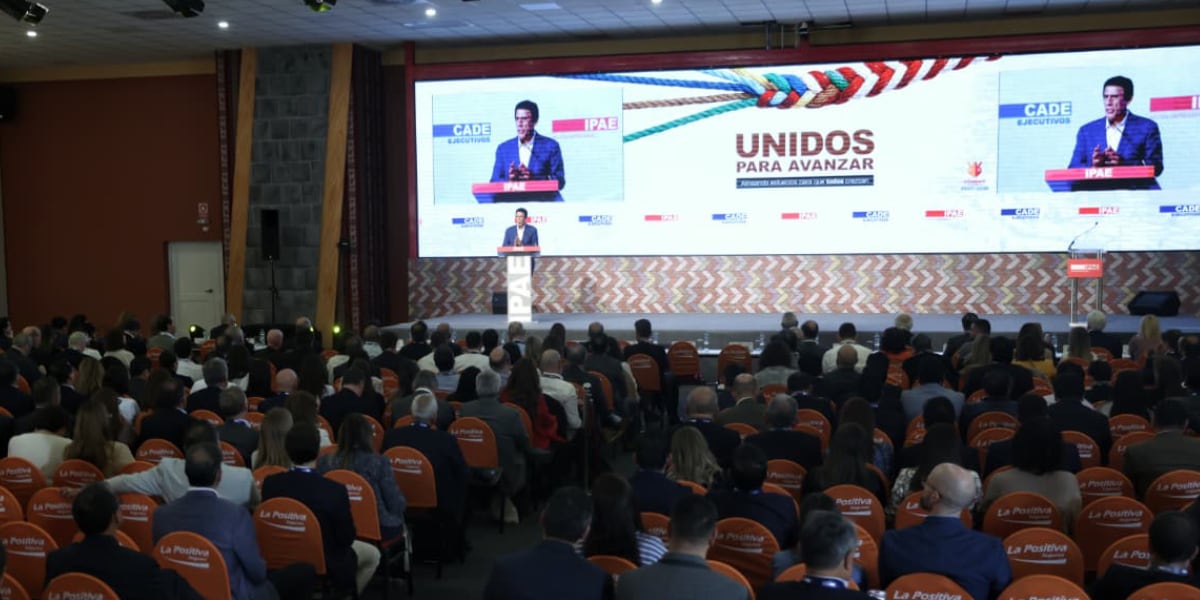
Business leaders, government officials and academics from Peru and abroad gathered on Tuesday in Urubamba, in the southern region of Cusco, for the opening of CADE Ejecutivos 2026, the 64th edition of Peru's annual business summit organized by IPAE Acción Empresarial.
The three-day event, held at the Vidawasi Children's Health Citadel under the slogan "Unidos para Avanzar" ("United to Move Forward"), will address Peru's main challenges and put forward proposals on growth, investment, decentralization, competitiveness and artificial intelligence. This year's central theme is how to promote investment and drive growth from Peru's regions.
IPAE Acción Empresarial is Peru's leading business association, and CADE Ejecutivos is the country's longest-running and most influential gathering of corporate executives and policymakers, held annually to debate the national economic outlook. Urubamba, the host city, sits in Peru's Sacred Valley near Cusco, a region known for its Inca heritage.
Opening remarks on commitment and inequality
In his opening address, IPAE Acción Empresarial president Gonzalo Galdos said that a vision for the country without commitment is an illusion, that commitment without action is only a promise, and that action without results is a lost opportunity.
Galdos asked how it was possible that a country with so much wealth and so many opportunities had still not managed to offer a dignified life to all its citizens.
Rolando Arellano Cueva, president of CADE Ejecutivos 2026, stressed the economic conditions that, in his view, allow for optimism about the country's future, while acknowledging that problems persist that still need to be addressed.
Arellano also highlighted Peru's potential in the face of technological change and artificial intelligence. He acknowledged that the technology threatens certain jobs, but argued that Peruvian productive activities still hold room for growth.
He reflected that for years, investment and development had concentrated in places where it was easiest to produce and do business, leaving other cities and sectors behind. Growing regional incomes, he said, now open an opportunity to change that dynamic.
Power outage briefly disrupts the opening day
A power outage lasting about an hour, which also knocked out the venue's backup system, interrupted the proceedings. The day continued once power was restored, opening with the summit's first scheduled presentation.
Latin America's place in a reordering world
The first session, titled "Globalization, the World Is Reordering Itself," examined what role Latin America will play in the changing global landscape and what opportunities that opens for Peruvian companies. It was led by Núria Vilanova of Spain, president of the Consejo Empresarial Alianza por Iberoamérica (CEAPI), a business council that promotes ties between Latin American and Spanish companies.
Vilanova said she likes to say that Ibero-America is the answer the world needs, noting the region holds everything wars are fought over, everything alliances are built on and everything that attracts investment, including some of the world's largest reserves of lithium, copper and oil.
She said foreign investment into Latin America has risen from 8% to 12% in recent years. For a long time, she said, the United States paid little attention to what happened in the region, but that has changed: Washington now cares about its politics and security, and large investment funds have begun pouring money into the region.
Vilanova added that the United States is not alone, noting that Spain has bet on Latin America for years and that, in Peru specifically, Spanish investment exceeds that of the United States.
She said the main agenda for companies today is transformation, adding that well-known brands are no longer enough if they lack a reputation for modernity and the capacity to innovate.
What's next at the summit
The summit continued with a presentation titled "How Is Our Economy Doing Today, What Should We Expect Tomorrow: A Comprehensive Vision of the Peruvian Economy Through 2026," delivered by Alvaro Monge, general manager at the economic consultancy Macroconsult.
What happens next
The three-day summit was continuing with a presentation by Macroconsult general manager Alvaro Monge on the outlook for Peru's economy through 2026.
Test yourself
Where was CADE Ejecutivos 2026 held?
According to Núria Vilanova, how has foreign investment in Latin America changed in recent years?
What briefly disrupted the opening day of the summit?
Have your say
Should Peru prioritize investment in its regions over the capital?
Where it happened
Urubamba, Peru