Cecilia Méndez, a historian and senior professor at the University of California, Santa Barbara, has written that a 1923 Peruvian schoolbook used the image of a flute-playing indigenous man to teach children they could never be "Indian" themselves.
In an essay for 247 News Agency, Méndez examined a copy of "El libro de la escuela elemental peruana," a primer published by Peru's Ministry of Instruction and approved by the government for elementary schools nationwide. The book was written by E. Guzmán y Valle, whose name now belongs to Peru's first public university dedicated to teacher training, popularly known as La Cantuta.
The copy Méndez studied is the eleventh edition, revised by a disciple of Guzmán y Valle named E. Ponce Rodríguez and billed as adapted to modern reading and writing methods. Méndez said the book was distributed free and in mass quantities to primary schools across Peru during the presidency of Augusto B. Leguía, even though the original text had already circulated for more than a decade.
A family heirloom
Méndez said the book once belonged to her grandmother, Trinidad Jurado, a rural teacher born in 1900 who lived with Méndez's father as a child in Musho, a village in the Ancash highlands at the foot of the Huascarán mountain. Jurado lived with Méndez's family until her death in 1973, when Méndez was a child.
The copy shows pencil scribbles and sketched letters, evidence that at least one child, possibly Méndez's own father, once used it. Méndez noted that her father, born the same year the book was published, would be 103 years old today.
Blond children on the cover
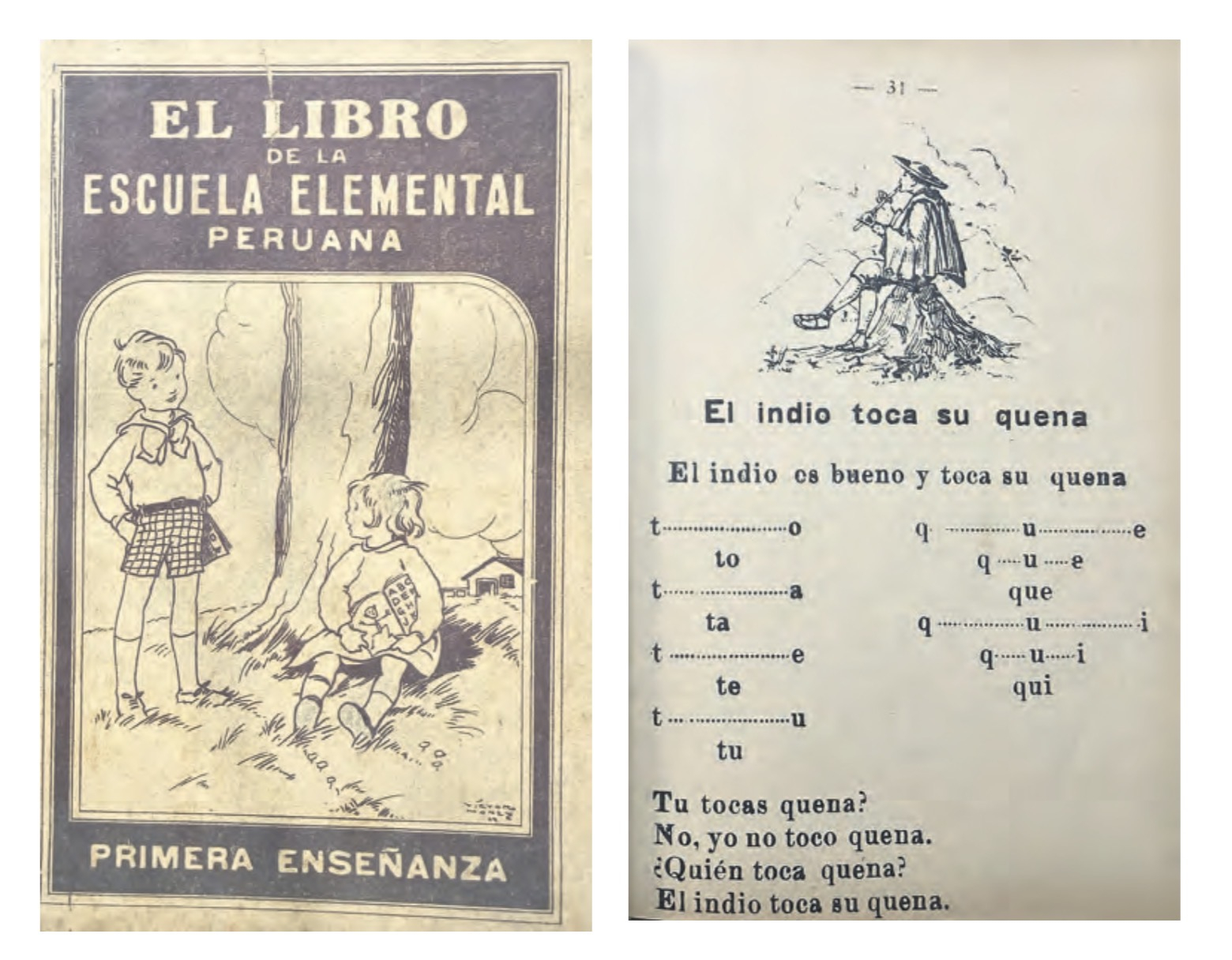
The cover illustration shows a blond boy and girl with European features. The boy stands confidently in plaid shorts, calf socks and a sailor shirt, looking down at the girl with a knowing air. She sits at the foot of a tree, younger than him, mouth half open in apparent wonder. A house with a sloped roof sits in the background, on a rural landscape that Méndez said bears no resemblance to the Andes.
Inside, more children appear alongside a mother, a grandfather, a teacher and neighbors, all white, in scenes Méndez compared to a mid-century American suburb of the segregation era. The children play with each other and with a dog named Fado through phonetics exercises and lessons on love of country, God, the commandments and military heroes.
The two figures who don't fit
Two characters break the pattern, Méndez wrote. One is a woman with braids, wearing a traditional lliclla shawl, pollera skirt and ojota sandals, shown carrying a child while Fado tries to reach the infant with his snout. Unlike the other characters, she does not interact with anyone.
The second is a man Méndez described only as "el indio," seated on a mound playing a quena flute against a backdrop of hills and clouds. Beneath the illustration, in translation, the text reads:
- The indio plays his quena.
- The indio is good, and plays his quena.
- Do you play the quena?
- No, I do not play the quena.
- Who plays the quena?
An "ontological impossibility"
Méndez argued that a reading primer is never innocent, since it teaches children how to see the world and how to see, or not see, themselves in it. She cited the historian Barbara Weinstein's observation that modernity carries a color.
She noted that while the dog in the book has a name and plays with the children, the indigenous man is only ever "the indio," and the text specifies that he plays "his" quena rather than "the" quena, a phrasing she said marks the instrument as a personal, alien trait rather than something shared. In her reading, the figure exists not to teach a positive lesson but to tell children they are not, and must not be, indigenous, which is why the claim that "the indio is good" rings false to her.
"That boy is you"
Méndez titled her essay That Indian Is Not You, a play on lines from two other lessons in the same primer, titled "The Homeland Needs a Girl" and "The Boy the Homeland Needs." After listing the qualities expected of children who serve their country, those lessons tell readers directly, in translation, that the girl or boy described is them. Méndez said the primer never needs to mention race explicitly, because the cover image and the verses about the quena player, cast outside the nation, make the point on their own.
A Quechua-speaking Peru
Méndez placed the book against the demographics of the period. She said Peru around 1900 was around 60% to 70% Quechua-speaking, rising to about 95% in regions such as Cuzco and Ayacucho, citing historian Alan Durston's 2019 book "La escritura en quechua." By 1940, she said, that share had fallen but Quechua speakers still made up more than half the national population.
Given those numbers, Méndez asked how rural, Quechua-speaking teachers and students were expected to reconcile the manual's anti-indigenous message without psychological harm, and how they lived with what she called a pedagogy of cognitive dissonance.
Questions about her own family
Méndez wrote that in Musho, the only difference between her father and the other children was that his mother was the town's teacher while theirs were peasant farmers. She said she does not know whether her grandmother used the manual or took it seriously, or whether her father learned through it to read Spanish while looking down on the Quechua he spoke with friends.
She asked what silences or shame her father and grandmother may have carried, and passed down to her, and how the children of Musho who resembled the braided woman or the quena player, rather than the blond children on the cover, felt when the book's rules forced them to suppress that identification.
A legacy that persists
Méndez closed by writing that she would like to call the book a relic of the past, but said the racism it prescribed still carries toxic power today. She said it survives in a self-congratulatory illusion of "including" the indigenous person, who can be called "good" only so long as he plays his quena, but is branded a second-class citizen or an obstacle to progress the moment he speaks in his own voice. She suggested that racism may be, in effect, a way of ensuring that voice is never heard.