Greece's state cash rebate scheme for international film productions has generated nearly 480 million euros in direct private expenditure across the country, with each 1,000 euros in public funding driving up to 43 foreign visitor arrivals, according to data from EKKOMED and a new econometric study by IOBE.
Leonidas Christopoulos, chief executive of the Greek Centre for Audiovisual Media and Creation (EKKOMED), presented the findings of the research by the Foundation for Economic and Industrial Research (IOBE) to the Athens-Macedonian News Agency. EKKOMED is the national public entity tasked with administering financial incentives and promoting screen infrastructure in Greece, while IOBE is a leading independent economic research institute based in Athens.
Christopoulos explained that every additional 1,000 euros in cash rebate state aid connects directly to between 31 and 43 extra arrivals of foreign visitors and 45 to 105 additional overnight stays. Based on average tourist expenditure figures, that public investment corresponds to roughly 17,700 euros to 24,600 euros in additional tourist spending. He noted that film productions create economic value twice, first during filming through direct local spending, and later when screen images travel globally to inspire new travel.
Direct economic impact of film productions
The financial footprint of international filming in Greece has grown substantially in recent years. Data from EKKOMED's Observatory reveals that 188 international productions and minority co-productions have received approval under the state cash rebate scheme since 2019. Cash rebates are financial incentives offered by governments to refund a percentage of qualifying production costs incurred locally by film and television projects.
For those approved productions, EKKOMED has paid out or is scheduled to pay approximately 270 million euros. In return, those film projects have generated or are expected to generate nearly 480 million euros in direct private expenditure within the Greek economy.
The economic impact of a major shoot extends well beyond the film industry itself. According to an independent study conducted by research consultancy Olsberg SPI, between 55 percent and 75 percent of production spending flows into sectors outside the purely audiovisual industry, benefiting hotels, restaurants, transport services, construction firms, equipment rentals, and local suppliers.
Christopoulos emphasized that the cash rebate program must be treated primarily as an investment tool rather than a public subsidy. The Olsberg SPI study demonstrated that for every single euro of public aid provided by the program, 4.20 euros of additional economic value is created in the Greek economy, even without counting the subsequent economic gains from increased tourism.
Measuring online popularity and tourist arrivals
While the relationship between major movie successes and regional tourism growth has long been noted informally, economic researchers sought to transition from general impressions to systematic measurement. The IOBE study demonstrated how online film popularity directly correlates with physical tourist movements.
The econometric findings show that for every 1,000 additional users who vote positively for a production featuring Greek locations on the Internet Movie Database (IMDb), filming locations record 500 to 770 more foreign arrivals. IMDb is an online database containing information, ratings, and reviews for films, television shows, and streaming content worldwide.
Christopoulos outlined plans for EKKOMED's Observatory to systematically track the economic footprint of major international titles before and after their release. The plan involves combining production filming data with tourist arrival numbers, hotel overnight stays, and regional spending. IOBE praised the Observatory initiative as a strong foundation and recommended expanding it with regional data streams.
Peloponnese leverages Christopher Nolan film
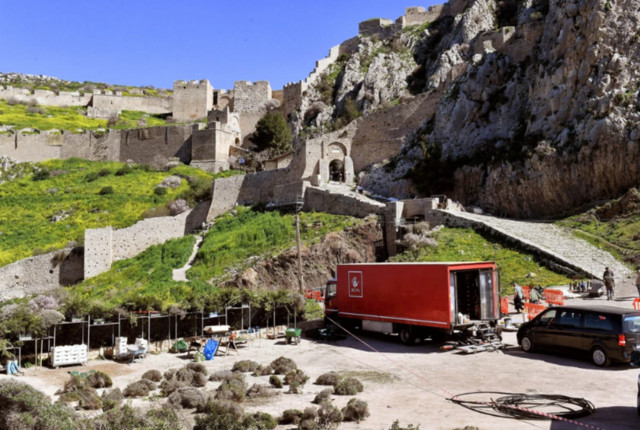
Regional authorities in the Peloponnese are already moving to turn international attention surrounding director Christopher Nolan's film The Odyssey into permanent tourist traffic. The Peloponnese is a large peninsula in southern Greece known for its ancient archaeological sites, mountainous terrain, and coastline.
Peloponnese Vice Regional Governor for Tourism Thanos Michelongonas told the Athens-Macedonian News Agency that The Odyssey brought the region's landscapes into the global spotlight and demonstrated its potential as a major filming destination. Nolan is a British-American director recognized for large-scale cinematic productions shot on physical locations.
Michelongonas explained that regional authorities are promoting filming locations through the VisitPeloponnese platform while coordinating with major international media outlets. Local officials are also developing a thematic travel route centered on Homeric Peloponnese to transform film publicity into a broader tourism product that supports local communities over the long term.
Long term tourism legacy in Skopelos
The long term sustainability of screen tourism is highlighted by the island of Skopelos, where the 2008 musical film Mamma Mia! continues to draw international travelers 18 years after its release. Skopelos is a lush island situated in the Aegean Sea, belonging to the Sporades island group.
Mary Diamanti, president of the Skopelos Hoteliers Association, stated that strong word-of-mouth recommendations among visitors continue to bolster the island's popularity. Diamanti noted that Skopelos possesses distinctive natural advantages, including pine forests covering approximately 80 percent of its land area, rich local gastronomy, good accessibility, and competitive pricing across different travel segments.
Despite these broader attractions, Mamma Mia! remains a consistent driver of visitor interest. An open-air cinema operates on the island, drawing tourists from countries including the United States, Finland, and Thailand specifically to view the movie where it was filmed. Diamanti added that some international tourists combine visits to historical landmarks in Athens, such as the Acropolis, with a short two-day stay on Skopelos to experience the film's settings.
Local businesses have created private tours and designated routes targeting key shooting locations, most notably the chapel of Agios Ioannis, which featured in one of the movie's main scenes. This cinematic legacy has spurred new economic activity across Skopelos, leading to increased taxi services, improved transit links, upgraded internal public transport, and new commercial ventures. Across the Sporades region, neighboring Skiathos has similarly incorporated the film's appeal into day cruise itineraries inspired by the musical.
Greece position in international film market
Greece has a long history of media productions driving regional visibility, including the film The Big Blue on Amorgos, Captain Corelli's Mandolin on Kefalonia, and the television series Maestro on Paxos. Amorgos, Kefalonia, and Paxos are Greek islands that experienced increased international recognition following screen appearances.
Christopoulos stated that Greece has made significant progress in recent years, evolving into an established international film market rather than relying on occasional production hits. He noted that while Greece offers some of the world's most competitive financial incentives, global competition among filming locations remains intense.
To secure a permanent economic advantage, Christopoulos stressed that natural landscapes and high cash rebates are not sufficient on their own. Greece must maintain a stable and predictable funding environment, streamline administrative approval speeds, expand studio facilities and filming infrastructure, strengthen post-production capacity, and invest in workforce training.
Christopoulos concluded that while earlier productions brought unmanaged visibility, Greece now possesses organized mechanisms, including investment incentives, a unified national agency in EKKOMED, and detailed empirical research, to capture long term value from every international project filmed on its territory.