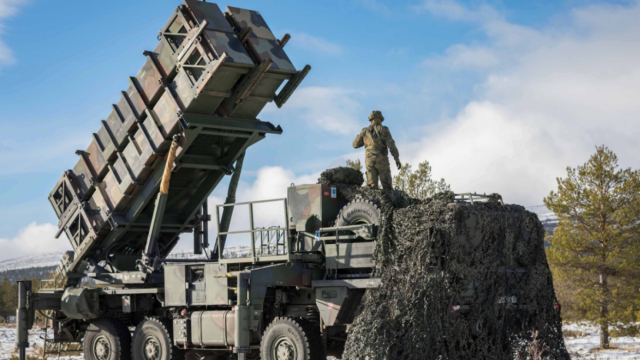
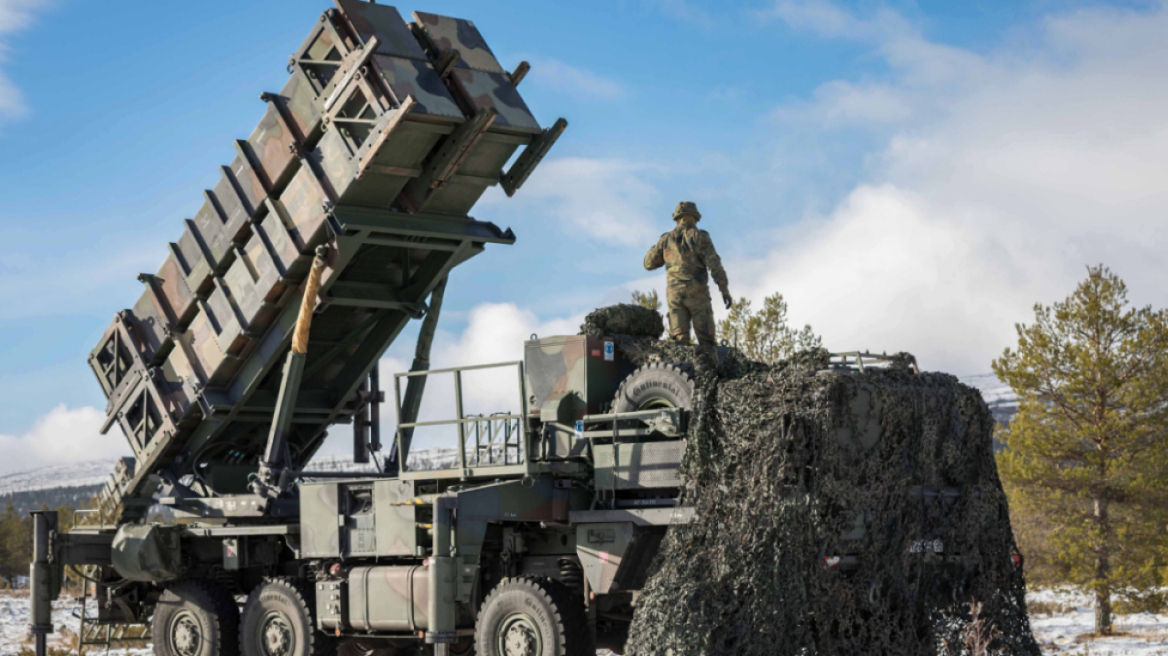
The Greek defence ministry is considering moving a Patriot missile battery from Karpathos to Crete following Iranian threats against European targets, officials said.
Military planners in Athens are reviewing the deployment to enhance anti-aircraft protection around Souda, where key strategic installations are located. Greek forces are also evaluating potential support for Bulgaria should Sofia request additional regional air defence coverage.
Hellenic Air Force fighter jets, flight crews, and a Hellenic Navy warship remain stationed in Cyprus. Greek military personnel have maintained a continuous presence on the island since previous Iranian attacks targeted the British base at Akrotiri, with regular troop rotations taking place.
The Patriot system is an advanced surface-to-air missile defence shield designed to intercept incoming aircraft, cruise missiles, and tactical ballistic missiles. Souda Bay in northwestern Crete hosts major Greek naval and air facilities, alongside significant NATO and United States military operations in the Eastern Mediterranean. Any decision to extend air defence coverage to neighbouring Bulgaria would require formal approval from KYSEA, the Government Council for National Security, which serves as the supreme defence decision-making body in Greece.
Iran Threats to European Infrastructure
The military reviews follow a report by the Financial Times revealing that Tehran has evaluated potential strikes against American military facilities in southeastern Europe. Two sources familiar with internal discussions in Iran stated that Tehran could broaden the conflict beyond the Middle East if US President Donald Trump initiates a new military escalation.
Iranian military scenarios specifically identified targets in Bulgaria, where Sofia approved the use of Bezmer air base by American refueling aircraft last month. Sources also cited Cyprus as a potential target for retaliation, noting that the British military base at Akrotiri was hit by an Iranian drone in March.
Separately, Iranian armed forces have examined plans to target subsea fiber optic communication cables in the Strait of Hormuz if hostilities escalate further.
Bezmer Air Base, located in southeastern Bulgaria, is a primary facility for Bulgarian air operations that frequently hosts joint military exercises with American forces. The Strait of Hormuz is a narrow, critical maritime passage connecting the Persian Gulf to the Gulf of Oman, carrying a significant portion of global energy exports and undersea telecom lines.
Political Shifts and Military Warnings in Tehran
Within Tehran, regime figures increasingly view a resumption of direct military conflict as inevitable. Talks aimed at reopening the Strait of Hormuz have stalled, while US President Donald Trump stated on Tuesday that no negotiations or contacts with Iran were taking place or scheduled.
Last week, Iran's Supreme Leader, Ayatollah Mojtaba Khamenei, appointed hardline figures to top positions across the country's security apparatus and armed forces. Commanders from the Islamic Revolutionary Guard Corps warned that in any future full-scale war, Iran will abandon its previous strategy of restricting attacks to US military bases and energy assets within the Middle East.
The Revolutionary Guards issued a direct warning to Britain last month regarding American access to British installations. Iranian military officials stated that any base utilized to launch attacks against Iranian territory would be treated as a legitimate military target.
The Islamic Revolutionary Guard Corps is a major branch of the Iranian Armed Forces that operates independently of the conventional military and oversees Iran's strategic missile program and regional operations. As Supreme Leader, Ayatollah Mojtaba Khamenei holds ultimate authority over Iran's armed forces, judiciary, and foreign policy decisions.
Missile Capabilities and Escalation Scenarios
Sidharth Kaushal, a research fellow at the Royal United Services Institute in London, described the threat posed by Iranian missiles to targets in Europe as real but limited.
Kaushal stated that Iran could deploy medium-range ballistic missiles, including weapons from the Shahab series, against American facilities in southern and southeastern Europe. However, he noted that such missiles would struggle to inflict heavy damage across longer distances.
Sources told the Financial Times that the extent of Iranian retaliation will depend entirely on actions taken by Washington. Trump warned last month that the United States would destroy an Iranian bridge or power plant every time Iran attacked a vessel in the Strait of Hormuz.
An Iranian source stated that Tehran is preparing comprehensive contingency plans if Washington targets Iranian infrastructure. The source warned that Tehran would set no limits on its response, stating that if the United States pushed too far, Iran would defend itself at any cost and expand its strikes into Europe.
The Royal United Services Institute, founded in 1831, is a leading defense and security think tank based in London. The Shahab missile family includes liquid-fueled ballistic missiles developed by Iran, capable of reaching targets across the Middle East and parts of southeastern Europe.