

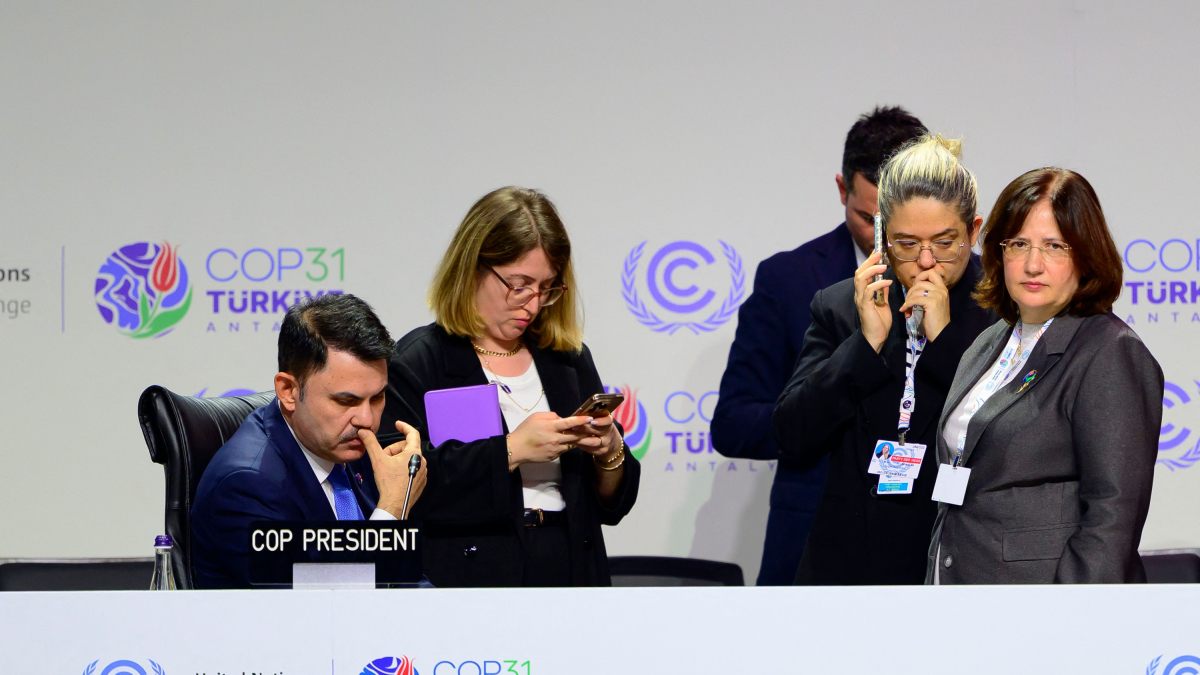
Economist Bjorn Lomborg has argued that the collapse of the COP31 United Nations climate summit in Antalya, Turkey, without a final agreement is good news for the planet, because it allows governments to stop pursuing climate policies that have failed for three decades and start doing what actually works.
In an opinion article, Lomborg wrote that three decades of climate summits have produced high energy bills and little else, and said the moment had come for a shift toward what he called climate realism.
Lomborg is president of the Copenhagen Consensus Center and a visiting fellow at the Hoover Institution at Stanford University. He is known for applying cost-benefit analysis to climate and development policy, often arguing that resources are better spent on adaptation and innovation than on rapid emissions cuts.
Energy costs and fossil fuel use
Lomborg said many climate summits worked politically because politicians could promise to save the planet while the costs only arrived later. Those costs, he said, are arriving now.
He pointed out that Spain pays about 22 cents per kilowatt-hour for households and industry combined, almost double what Americans pay and nearly two and a half times more than Chinese consumers pay.
He said the summits have rarely delivered results. At the Glasgow summit in 2021, the world famously pledged to phase down coal use, he noted, but global coal use has set a new record every year since. He added that even if every pledge under the Paris Agreement were met, it would achieve only 1% of the emissions cuts needed to keep warming below 1.5 degrees Celsius.
He described it as ironic that Spain and the rest of Europe lectured the world on ending fossil fuels, the very issue he said sank the negotiations in Antalya. Spain still gets 68% of its energy from fossil fuels, he said, and the European Union gets almost two-thirds. Following the trend of the past decade, Lomborg said Spain will still source more than half its energy from fossil fuels in 2050, the year it has pledged to reach net zero emissions.
Rich nations versus the rest of the world
Lomborg argued that emissions from wealthy nations are becoming increasingly marginal. He said more than 83% of emissions for the rest of the century will come from countries outside the Organisation for Economic Co-operation and Development. Spain's emissions, he said, amount to just 0.2% of the global total, and the entire European Union accounts for only 2.8%.
He acknowledged that climate change is real but described it as a byproduct of prosperity, noting that cheap and abundant energy, mostly from fossil fuels, has driven two centuries of growth that lifted billions of people out of poverty.
Lomborg said most poorer countries do not want to copy Spain's high energy costs or its rising debt. Instead, he said, they look to China and want far more energy, mainly from fossil fuels, and want to be paid to control their emissions. He recalled that in 2009 rich countries promised an additional $100 billion a year but mostly delivered relabeled aid and loans, and that in 2024 they promised $300 billion while discussing figures as high as $1.3 trillion, money he said would never materialize.
The cost of reaching net zero
Lomborg said the fundamental problem with the COP approach is that rapidly cutting emissions costs more than it delivers. He put the global cost of reaching net zero by 2050 at 220 trillion euros, with each euro spent delivering only 9 cents of climate benefit.
For Spain alone, he said, reaching net zero by 2050 would cost 325 billion euros and would lower the global temperature by the end of the century by two thousandths of a degree. Even if the whole European Union reached net zero, he said, it would spend 4.3 trillion euros to make the world less than three hundredths of a degree cooler by 2100.
Lomborg said the COP process will likely continue but should not continue in its current form, and that the collapse of COP31 finally allows the question of what actually works to be asked.
Lomborg's proposed alternative: innovation and adaptation
First, Lomborg called for greater investment in innovation. He said the only way to get the whole world to cut emissions is to make green energy cheaper than fossil fuels, which he said requires funding better baseload technologies, such as cheap fourth-generation nuclear power, rather than subsidizing increasingly intermittent solar and wind power. If green energy became the cheapest option, he argued, the whole world would switch rather than only a few wealthy, well-meaning countries making modest cuts.
He said the European Union spent about 392 billion euros on the green transition last year but only around 10 billion euros, about 2.6%, on research and development to make green energy cheaper. Lomborg said Europe could cut unnecessary green spending, quadruple its innovation spending to 36 billion euros a year, and still save money overall. Spain itself, he said, spends only 1.8 billion euros a year on green energy research and development, equal to 0.11% of its gross domestic product, short of a recommended 0.2%, which would amount to 3.2 billion euros.
Second, Lomborg called for addressing climate vulnerability directly. He said simple adaptation measures, such as early warning systems, air conditioning, flood defenses and more resilient crops, work and avoid much of the damage caused by emissions while paying off far better than carbon cuts. He said most people are vulnerable to climate because they are poor, and that development makes people healthier, better fed and better educated while also making them far more resilient to climate impacts. The world needs to become richer, not poorer, he said.
Lomborg said the old climate consensus, the belief that rich countries can make themselves poorer while the rest of the world follows, has disappeared. He said the collapse of COP31 should mark the end of what he called virtue signaling in Europe and the beginning of climate realism built on innovation, adaptation and economic growth.
What happens next
Lomborg said the COP process will likely continue, but argued it should not continue in its current form.
Test yourself
What did Bjorn Lomborg say was the global cost of reaching net zero by 2050?
According to Lomborg, roughly what share of Spain's energy still comes from fossil fuels?
What alternative approach did Lomborg propose instead of rapid emissions cuts?
Have your say
Should wealthy countries prioritize cutting emissions quickly or investing in cheaper green technology and climate adaptation?
Where it happened
Antalya, Turkey


