

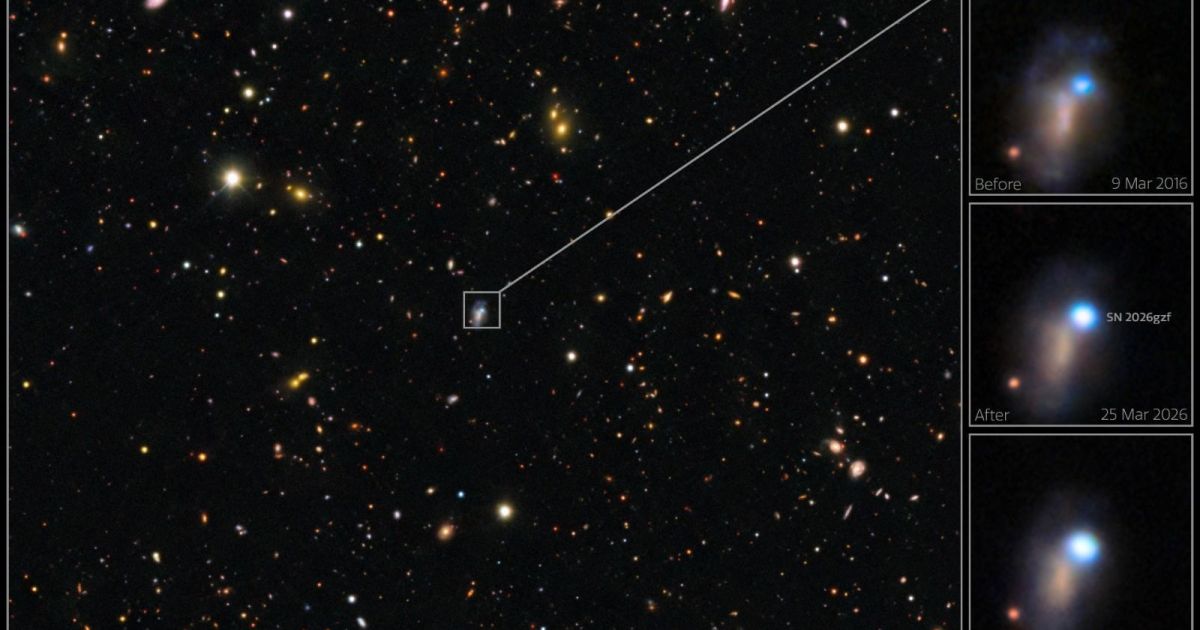
Astronomers have observed the entire explosive death of a massive star from start to finish, gaining new insights into how giant stellar cores collapse in a galaxy located roughly 500 million light-years from Earth.
The rare event began in March when the Chinese space telescope Einstein Probe detected a momentary flash of X-rays. The flash was triggered by a powerful shockwave created as the collapsing core exploded and tore through the surface of the doomed star.
Scientists call this phenomenon a shock breakout. Although astronomers believe shock breakouts occur during all supernova explosions, they are exceptionally difficult to detect because of their brief duration, making this event the first observed since 2008.
Following the initial detection, researchers quickly mobilized an international array of astronomical instruments. The team used the orbiting Chandra X-ray Observatory alongside ground-based observatories to track the supernova for nearly three months, continuing observations until the star passed behind the Sun from the perspective of Earth.
Tracking the shockwave and stellar properties
Two research teams analyzed the findings in scientific papers published in Astrophysical Journal Letters. Brendan O'Connor, a postdoctoral researcher at Carnegie Mellon University in Pittsburgh, served as the lead author of one study, while Jillian Rastinejad, a NASA Einstein Fellow at the University of Maryland, led the second investigation.
O'Connor said that capturing a shock breakout in real time requires a degree of luck. Rastinejad explained that the shockwave functions like radar, leaving a signature in the X-ray signal as it travels through the outer stellar layers and surrounding material to provide an unprecedented close-up view of the star on the brink of collapse.
Astronomers estimated that the doomed star had roughly 30 times the mass of the Sun before it exploded. Prior to its collapse, the object was classified as a Wolf-Rayet star, a rare category of massive giant that has shed its outer hydrogen and helium layers through powerful stellar winds.
Rastinejad said the object would rank among the most massive stars known, likely larger than Betelgeuse. Betelgeuse is a well-known red supergiant located in the Milky Way galaxy between 500 and 600 light-years from Earth, which scientists also expect to die in a supernova explosion. A light-year measures the distance light travels in one year, equal to approximately 9.5 trillion kilometres.
Supernova classification and missing gamma rays
Astronomers classified the explosion as a broad-line type Ic supernova. Debris ejected by the blast traveled at extreme speeds, reaching slightly more than 10 per cent of the speed of light.
Researchers believe the violent collapse left behind a black hole, an extraordinarily dense astronomical object with gravitational pull so strong that not even light can escape from it.
The supernova displayed many characteristics typically seen in massive stellar explosions associated with gamma-ray bursts, which are intense flashes of gamma radiation representing the highest-energy form of light. However, observations revealed no evidence of a gamma-ray burst occurring during this explosion.
New insights into massive star deaths
O'Connor said one of the principal unanswered questions in astrophysics is why some collapsing massive stars launch jets of material at near-light speeds that escape the star and produce gamma-ray bursts, while other seemingly similar stars do not.
This observation marks the first broad-line type Ic supernova detected without an accompanying gamma-ray burst or jet of material. Rastinejad said the discovery demonstrates that the most massive stars in the universe die in more ways than astronomers previously imagined.


