

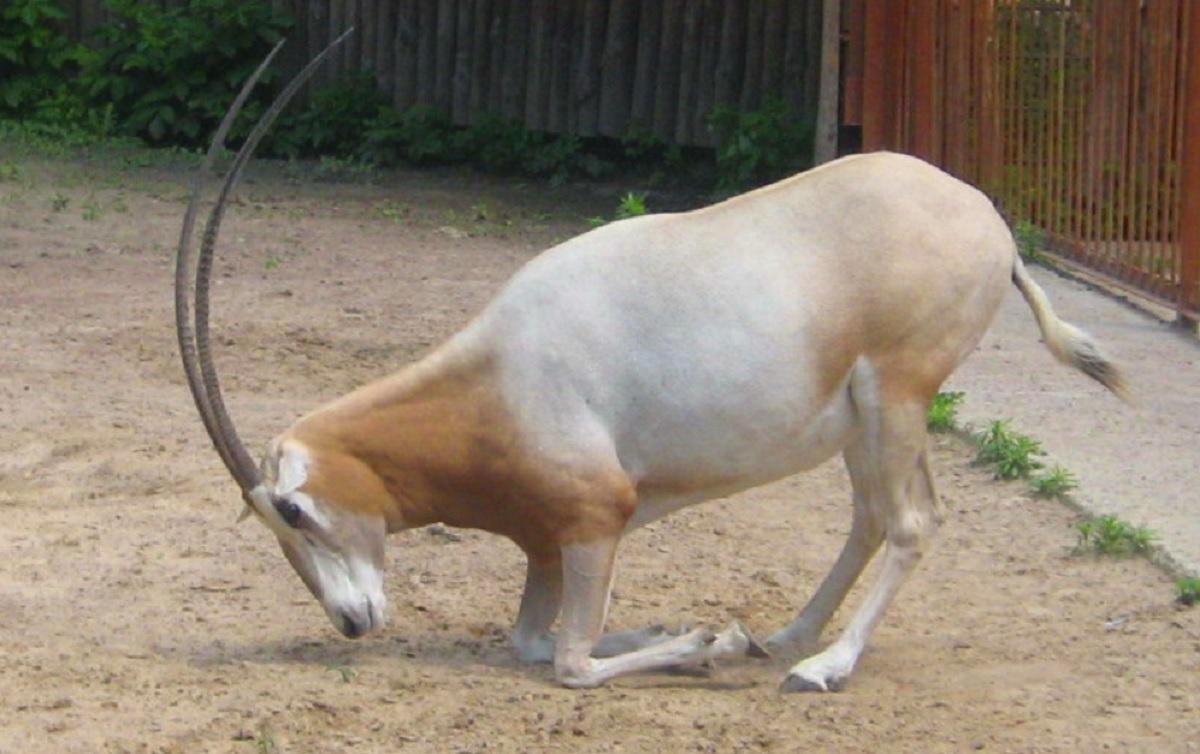
The scimitar-horned oryx, an iconic North African antelope declared extinct in the wild more than two decades ago, is roaming the savannas of Chad once again with a population exceeding 600 animals.
International conservationists have successfully rebuilt a self sustaining herd in the Ouadi Rime-Ouadi Achim Faunal Reserve, reversing a collapse caused by habitat loss and uncontrolled hunting in the 20th century.
The scimitar-horned oryx is uniquely adapted to the harsh, dry climates of the region. The animals are easily recognised by their bright white coats, rust coloured necks, and the long, sweeping horns that curve backwards like a sword, which give the species its name.
They were once a common sight across the semi arid fringes of the Sahara. However, their numbers plummeted rapidly as human encroachment and hunting pressure intensified. According to environmental scientists, the last confirmed photograph of a wild scimitar-horned oryx was taken in Niger in 1980, high in the Air Mountains.
In 2000, the species was officially categorised as extinct in the wild on the global Red List. While no animals remained in their natural habitat, small numbers survived in captivity across various zoos and private nature parks around the world.
Creating a world herd
The path to reintroduction began when a global team of conservation specialists started selecting captive animals to form the foundation of a new wild population.
The effort centered on establishing a genetically diverse world herd in Abu Dhabi, the capital of the United Arab Emirates. This foundational herd gathered stock from captive populations held in the United States, Europe and the UAE itself, ensuring the new population would have the genetic health required to survive.
The active reintroduction program marked its turning point in March 2016, when the first 25 scimitar-horned oryx were flown from Abu Dhabi to Chad.
The animals were transported to the Ouadi Rime-Ouadi Achim reserve, a vast protected area of Sahelian savanna. The Sahel is a transitional ecoregion of grasslands and steppes stretching across Africa, perfectly suited to the oryx.
Before their release, the newly arrived animals were kept in specially designed acclimatization enclosures. Experts monitored their health and behavior closely. Once they had adjusted to the local climate and vegetation, a pioneering group of 23 oryx was released into the wider reserve.
Tracking survival and growth
The conservation team fitted some of the released oryx with satellite GPS collars to track their movements, monitor their survival and map their territory across the reserve.
The primary goal of the project was not simply to place animals back into the wild, but to establish a robust population capable of breeding without relying on external additions.
Success came quickly. The project recorded the first wild birth of a scimitar-horned oryx calf in Chad in December 2016, proving the animals could reproduce in their ancestral environment.
Over the following years, the population expanded significantly. While captive bred animals continued to arrive from Abu Dhabi, wild born calves began playing an increasingly dominant role in the recovery of the species.
By the end of 2023, the wild herd surpassed 600 animals, comfortably beating the initial program target of 500 individuals. Between 2016 and 2023, a total of 285 captive oryx were delivered to Chad, while more than 500 were born in their natural habitat.
Overcoming extreme weather
The program has faced significant challenges despite its overall success. Reintroducing animals to the wild carries inherent risks, and the climate of the Sahel can be unforgiving.
At the end of the 2024 dry season, the region suffered a period of unusually hot weather that took a heavy toll on the herd. Ecologists reported that more than 100 scimitar-horned oryx died during the extreme heatwave.
The harsh conditions were particularly devastating for young animals and those that had only recently been released into the wild, as they had less time to adapt to the rigorous environment.
However, the population proved resilient and rebounded after the seasonal rains returned to the savanna.
A 2024 report by the scientists managing the program documented a total of 580 oryx born in the wild up to that point. Continued efforts saw another 50 oryx flown from Abu Dhabi to Chad in November 2024, bringing the total number of reintroduced animals to 385 since the flights began.
Change in conservation status
The growing numbers in Chad have already altered the official standing of the species. In December 2023, ecologists updated the status of the scimitar-horned oryx on the Red List, the comprehensive inventory of the global conservation status of biological species.
Thanks to the successful breeding program, the species was moved from extinct in the wild to the endangered category, marking a rare and significant conservation victory.
Today, the recovered herd continues to roam the protected Sahelian landscape. Conservation specialists maintain their watch over the animals, using field studies and satellite tracking to monitor their distribution, reproduction and long term survival.


