


Saudi Crown Prince Mohammed bin Salman, Turkish President Recep Tayyip Erdogan and Pakistani Prime Minister Shehbaz Sharif signed a joint defense pact in Mecca last Friday. The agreement between the three Sunni Muslim majority states aims to increase defense cooperation during a period of regional uncertainty and threats from the Iran-Iraq war.
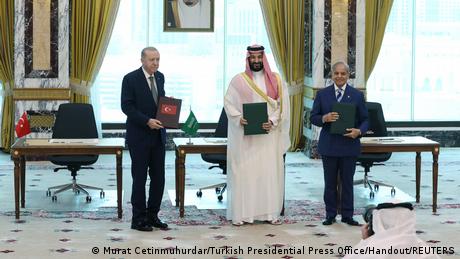
The Mecca Joint Defense Agreement aims to strengthen collective deterrence against any act of aggression. Following the signing, the Pakistani Foreign Ministry stated that an attack on any member state would be considered an attack on all three nations.
Although the alliance has been likened to a NATO-type arrangement, experts and analysts said the agreement is unlikely to function that way at first. Over the weekend following the signing, the Houthi rebel group in Yemen fired again on Saudi Arabian oil facilities.
Regional Security and Deterrence
The Houthis view Saudi Arabia as an enemy and are allied with Iran. Iran has also targeted Saudi Arabia after an attack by the United States and Israel launched a war in late February, because Iran views the Saudis as an American ally.
Neither Turkey nor Pakistan rushed to defend Saudi Arabia after the weekend Houthi attack, and analysts said neither country is likely to attack Iran. Pakistan currently prefers to serve as a mediator between Iran and the United States.
Dania Thafer, executive director of the Washington-based think tank International Gulf Forum, told Deutsche Welle that the agreement makes more sense as a deterrent and a flexible defense pact. Thafer explained that while Saudi Arabia is in the middle of the conflict, Turkey and Pakistan maintain relations with both Iran and the United States, providing an extra layer of deterrence for Saudi Arabia as it adopts a multi-layered approach to regional threats.
Kamran Bokhari, a senior fellow at the Center for Middle East Policy in Washington, told Deutsche Welle that the new alliance will likely operate in stages to create a more stabilized region in the short term.
Military Capabilities and Technology Transfer
Other experts noted that the long-term goals of the agreement focus on defense cooperation rather than conflict. Andreas Krieg, a lecturer in security at King's College London, told Agence France-Presse last week that the three countries complement each other unusually well.
Krieg explained that Saudi Arabia possesses oil wealth but limited defense technology and has depended on the United States. Meanwhile, Turkey and Pakistan need investment and maintain strong armed forces.
Turkey features an advanced defense-industrial sector with technology and production capacity that requires markets and investment. Pakistan is the only nuclear-armed state among the three, bringing manpower, military institutions, and nuclear deterrence while seeking funding and industrial capabilities.
Regional Scope and Diplomatic Positioning
A Turkish official cited by Reuters stated that the agreement is purely defensive, open to any regional neighbor wishing to sign, and does not replace or invalidate previous bilateral or multilateral agreements among the signers. The official added that the pact is not directed at a specific threat, though analysts view it as a deterrent mainly against Iran and Israel.
Egypt is considered a potential partner, but it must balance other allies including the United Arab Emirates. The United Arab Emirates has not joined the alliance, and relations between the UAE and Saudi Arabia are currently strained.
Khalid al-Jaber, director of the Doha-based Council for Global Affairs of the Middle East, wrote in an opinion piece for Qatari news agency Al Jazeera that the agreement does not aim for military victory. Al-Jaber wrote that reduced American influence could leave the region dominated solely by Israel and Iran, making the Mecca agreement an early attempt to build a third pole to prevent either power from holding a regional monopoly.
Reactions from Israel and Iran
Pakistan and Saudi Arabia do not recognize Israel or maintain official diplomatic relations with it, although covert ties likely exist in Saudi Arabia's case. Turkey recognizes Israel, but relations are strained due to Israeli actions in Gaza, which Turkey has described as genocide.
Erdogan stated last week that Israeli actions in Syria and Lebanon also threaten Turkish security. Osrit Birvadker, a researcher at the Jerusalem Institute for Strategy and Security, wrote that the agreement poses major challenges for Israel, delays normalization prospects with Riyadh, trims the vision of a new Middle East, and will heighten friction between Turkey and Israel.
The Institute for National Security Studies at Tel Aviv University analyzed Iranian reactions to the agreement. Iranian Foreign Minister Abbas Araghchi posted on social media platform X, formerly Twitter, that when Muslims stand united, they can face any challenge from malicious outsiders head-on.
Observers interpreted Araghchi's comments as supporting Iran's argument for removing the United States from the region. Some Iranian observers believed Saudi Arabia may be trying to leverage Turkish and Pakistani ties with Iran for safety, while other Iranian politicians criticized the move, stating Saudi Arabia was not safe with the United States and will not be safe with Turkey and Pakistan either.


