

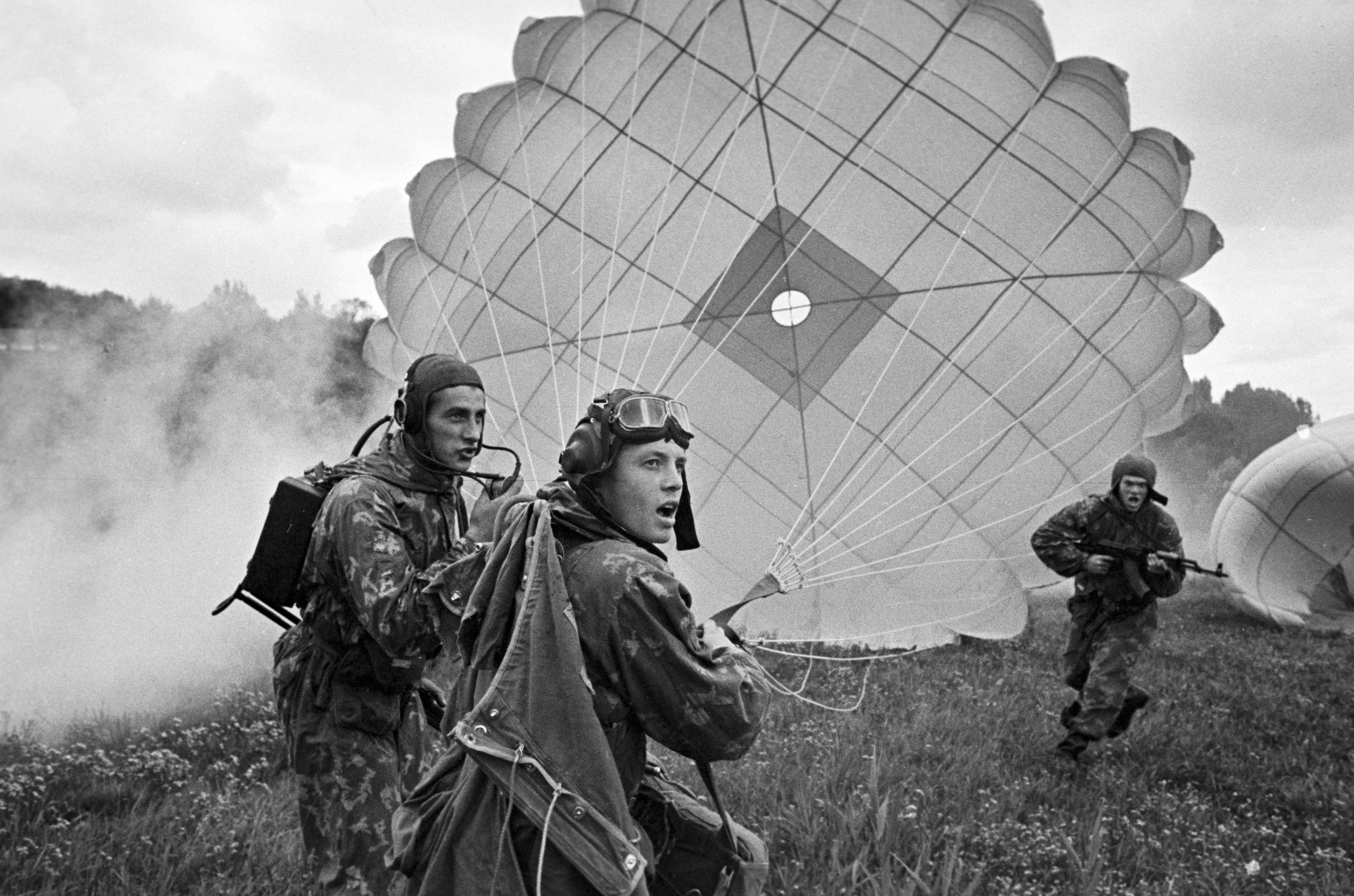
Russia's Airborne Forces marked their 96th anniversary on August 2, a date tied to blue berets, striped undershirts and the tradition of bathing in public fountains. Behind those rituals lies a history stretching back 96 years and through hundreds of battles.
Hill 3234
One engagement above all others anchors the holiday in memory. On the night of January 7 to 8, 1988, 39 paratroopers from the 9th Company of the 345th Separate Parachute Regiment held a position at Hill 3234 in the Afghan mountains. Between 200 and 400 mujahideen fighters attacked in continuous waves. The defenders ran low on ammunition, bandaged their own wounds to save time and held on under orders not to surrender the height.
When dawn broke, the position was still theirs. Six Soviet soldiers died and 28 were wounded. Insurgent casualties were described as significant but were never precisely established.
Origins
The VDV trace their official birth to August 2, 1930, when 12 men completed the first group parachute landing during military exercises near Voronezh. The groundwork had been laid a year earlier: in 1929, a small Red Army unit airlifted into Tajikistan near Garm disoriented and defeated a numerically superior Basmachi force, demonstrating the combat value of air-delivered troops. That same year the Red Army's first parachutist, Leonid Minov, was sent to the United States to purchase parachutes and study techniques. Early tests had troops jumping from 350 and 500 metres while weapons were dropped from 150 metres to measure dispersal and deployment time.
By the mid-1930s parachuting had become a mass sport and a symbol of Soviet modernity. At the first All-Union Stakhanovite conference, Marshal Klim Voroshilov declared that the Red Army had mastered the art of parachuting not merely as a sport that tempered courage but as a branch of combat power, and that no other country in the world could match the USSR in this field. Historians note that the Soviet Union formed airborne units before any other nation: Germany began building its Fallschirmjager only in 1936, while France, Britain and Italy did not do so until World War II.
World War II
When Germany invaded the Soviet Union on June 22, 1941, the VDV entered combat almost immediately, fighting in Latvia, Byelorussia and Ukraine. In October 1941, with no other units available near Yukhnov, Captain Starchak led 400 paratroopers who held advancing German armour for five days. Starchak told his men that the enemy tank column, if unopposed, could reach Moscow in five or six hours, and asked who else would stop it if they did not. That resolve eventually crystallised into the force's motto: nobody but us. The action bought time for the defence of the capital at a heavy cost in lives.
The largest VDV operation of the war was the Vyazma airborne operation in January and February 1942, in which around 10,000 paratroopers of the 4th Airborne Corps, operating alongside cavalry under General Belov, covered roughly 600 kilometres behind German lines and destroyed up to 15,000 Wehrmacht soldiers and officers. Marshal Zhukov praised the operation highly.
The Margelov Era
The modern shape of the VDV was largely the work of Vasily Margelov, appointed commander in 1954. Over 20 years he restructured divisions on a three-regiment model, reinforced them with artillery and reconnaissance, and secured specialised equipment including the BMD-1 infantry fighting vehicle. He developed techniques for dropping crews inside their vehicles and introduced rigorous physical and tactical training, hand-to-hand combat and survival skills. The blue beret and the striped undershirt became the force's visual identity under his direction. After watching a British film in 1964, he ordered rugby added to training as well.
Margelov described the essence of parachute service as something no outsider could fully understand: only someone who had left an aircraft from altitude, experienced free fall and felt wind strike their chest, could grasp a paratrooper's honour and pride. He made more than 60 jumps himself, the last at the age of 65. The competition to enter the Ryazan Airborne School under his tenure surpassed that for the country's leading theatre and film institutes; candidates who failed entrance exams reportedly lived in forests near Ryazan for months hoping for a vacancy.
Today
Since the Soviet Union dissolved in 1991 the VDV have continued as an independent branch. They are described today as a highly mobile reserve capable of rapid deployment anywhere, able to seize strategic targets and conduct peacekeeping and counter-terrorism operations using combined landing methods, either independently or alongside other branches.


