


Northwestern University researchers have created an experimental fabric coating inspired by melanin that destroys lethal nerve agents and neutralises their dangerous chemical byproducts.
The composite treatment combines allomelanin, a dark pigment found in fungi, with the metal zirconium to transform standard protective clothing into an active chemical shield.
Published in the scientific journal ACS Nano, the 12-year project was designed to produce high-efficacy personal protective equipment against nuclear, biological and chemical threats.
The initiative seeks to prevent highly toxic substances from penetrating protective garments and entering the body, where they can block the central nervous system and cause fatal collapse.
Nerve agents rank among the deadliest chemical weapons ever manufactured, while closely related toxic compounds form the basis of many agricultural pesticides. In both battlefield and industrial environments, exposure to even microscopic droplets can incapacitate or kill a person within minutes.
Limitations of traditional protective gear
Standard personal protective equipment issued to military personnel and emergency crews relies primarily on dense physical barriers or layers of activated carbon.
While traditional suits can prevent direct contact with hazardous liquids and vapours, they function purely as passive traps. The toxic compounds remain trapped inside the garment fibres, leaving the fabric contaminated and presenting severe exposure hazards when workers take their gear off.
The team at Northwestern University, based in the United States state of Illinois, sought to eliminate that danger by developing a fabric treatment capable of destroying toxic substances upon contact.
Twelve years of research
Developing the formulation required 12 years of laboratory work to produce a substance that chemically degrades toxic agents without releasing harmful secondary chemicals in the process.
The scientists achieved their initial breakthrough in 2015, when experiments demonstrated that zirconium-containing materials possess the natural capacity to accelerate the breakdown of toxic chemical agents.
Over the subsequent decade, the researchers investigated ways to combine zirconium with biological compounds to make the chemical breakdown suitable for everyday protective textiles.
Melanin is widely known for establishing the pigmentation of human skin, hair and eyes, while serving as a natural shield against harmful ultraviolet sunlight. For this project, however, the researchers focused on allomelanin, a specific type of melanin produced by fungi that excels at absorbing small molecules and heavy metal ions.
Microscopic sponge technology
Inside the fabric coating, allomelanin functions as a microscopic sponge. Its porous matrix captures small toxic molecules and binds heavy metal ions as soon as they encounter the cloth.
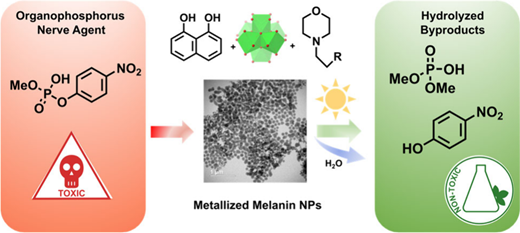
Once those hazardous molecules are trapped, the zirconium breaks them down chemically. The metal drives the reaction by using ambient moisture from the surrounding air as a catalytic trigger, operating continuously without requiring power supplies or separate chemical washes.
The mixture is applied directly to fabrics in a procedure similar to conventional textile dyeing. The application alters the chemical characteristics of the underlying fibres without changing their outward appearance or texture.
Neutralising hazardous byproducts
A major obstacle in chemical decontamination is that breaking down a toxin often generates secondary chemical compounds that carry their own health dangers. In the Northwestern experiments, the catalytic breakdown of the attacking substance produced two distinct byproducts: dimethyl phosphate and methylnitrophenol.
Dimethyl phosphate presents no known toxic risk, but methylnitrophenol poses a severe threat to living tissue.
The allomelanin component solved the problem by actively absorbing the hazardous byproduct and suppressing its concentration. During laboratory trials, the team observed that toxic levels of methylnitrophenol fell by half within just 10 minutes.
Future testing and commercial production
Nathan Gianneschi, a co-author of the study, said the findings provided researchers with a valuable range of approaches and materials to optimise and develop for protective applications.
Gianneschi noted that the achievement served in many respects as a proof of concept for a new direction in the way scientists design materials and protective coatings.
The researchers stressed that further testing is required before the melanin-based coating can enter commercial-scale production.
Once perfected for manufacturing, the developers expect the technology to safeguard military personnel exposed to chemical warfare, as well as industrial operators and agricultural workers handling highly concentrated pesticides.


