


A NASA-contracted spacecraft called LINK began spinning uncontrollably more than 320 kilometers above Earth on July 25, 2026, threatening a mission designed to rescue the aging Swift space observatory before it falls out of orbit. Engineers at Katalyst Space Technologies and NASA are now racing to stabilize the vehicle using only the equipment that survived the malfunction.
LINK was built and is operated by Katalyst Space Technologies, a company that specializes in servicing satellites already in orbit. NASA awarded the firm a $30 million contract for the mission, marking the first time the agency has handed maintenance of one of its satellites to a private company.
The target of the mission, the Neil Gehrels Swift Observatory, cost $500 million and launched in 2004 to study gamma rays and other cosmic phenomena. The observatory still works, but it has no propulsion system capable of raising its own orbit. Thin atmosphere at its altitude creates drag that is slowly pulling it lower, and within a few months it will be too low for LINK to safely capture and lift.
LINK launched on July 3, 2026, and the mission was proceeding as planned until the spacecraft began rotating on multiple axes during a period when it had no communication with ground control. Ghonhee Lee, chief executive of Katalyst, told Ars Technica that just before the incident, the spacecraft had been in a very stable configuration.
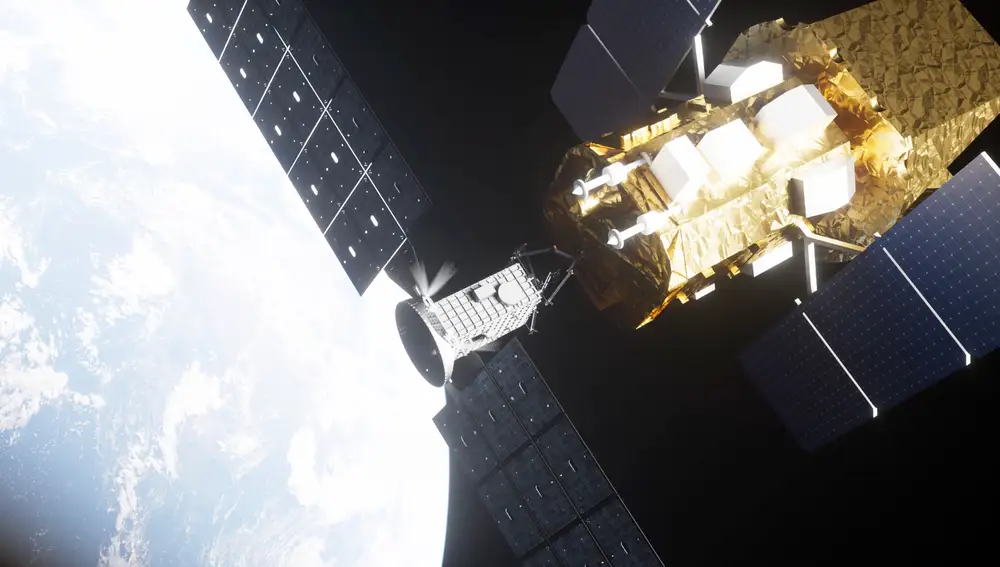
The rotation made it difficult to maintain a stable connection with the control center and complicated any attempt to regain command of the spacecraft. Two of its three reaction wheels stopped working, and engineers also detected an additional problem in part of the cold gas thruster system.
How reaction wheels and the reset failure combined
Reaction wheels are disks driven by electric motors that let a spacecraft orient itself without expelling propellant. When a wheel speeds up or slows down, it transmits an opposing motion to the rest of the vehicle, and combining several wheels lets engineers control orientation across all three axes.
After the uncontrolled spin began, the team lost contact with LINK for more than 24 hours. The spacecraft then triggered an automatic reset built for situations in which it goes too long without receiving instructions. That procedure abruptly cut power to its systems, which raised the temperature in the electronic circuits controlling the reaction wheels.
Lee said the reset essentially disconnects every system at once, producing a series of effects on sensitive components such as the reaction wheels. The resulting temperature spike left two of the three wheels unusable. He said the cold gas thruster failure appears to be a separate problem, though Katalyst still lacks enough data to determine what triggered the emergency and what damage was a consequence of it.
Reprogramming LINK's flight controls
Katalyst engineers, working with NASA control specialists, are developing a system meant to stabilize LINK and let it continue the mission. The plan involves reprogramming the guidance, navigation and control algorithms so the spacecraft can be flown using its one remaining reaction wheel, its available thrusters and its three xenon-fueled electric motors.
Those plasma engines were installed to raise orbits, but they can also help slow the spin. Each one sits on a two-axis gimbal, a joint that lets the engine tilt in two directions so its thrust can be aimed without having to move the whole spacecraft first.
Lee said the team has been able to use the thrusters to point opposite the direction of rotation to control the spacecraft's attitude, calling the approach very effective. He noted the electric system produces little thrust and needs time to create noticeable change, but it has already cut the rotation speed from about 9 degrees per second to roughly 4 degrees per second.
Checking for space debris damage
A slower rotation will support higher-capacity communications and allow the team to download detailed data on LINK's condition. Katalyst also plans to use two onboard cameras to look for signs of a collision with space debris, one of the possible causes being considered for the malfunction.
The company is still aiming to approach Swift by late August. Lee said nothing appears to be stopping the team from restoring control of the spacecraft across all three axes. He said the method will differ from what was originally planned, but he believes LINK can still close to within a few dozen meters of the observatory, inspect it and attempt to grab hold of it. Lee said capturing Swift, or at least attempting to, remains a very real possibility.


