

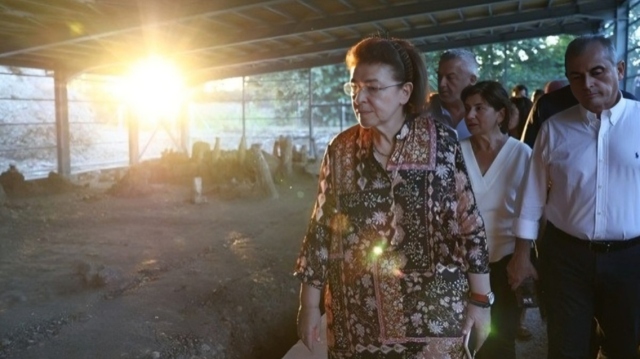
Greece's Culture Minister Lina Mendoni has described the Kasta tumulus and the wider archaeological complex at Amphipolis as a unique cultural hub and a major engine of development, speaking at a ceremony to mark the public opening of an upgraded ancient wooden bridge.
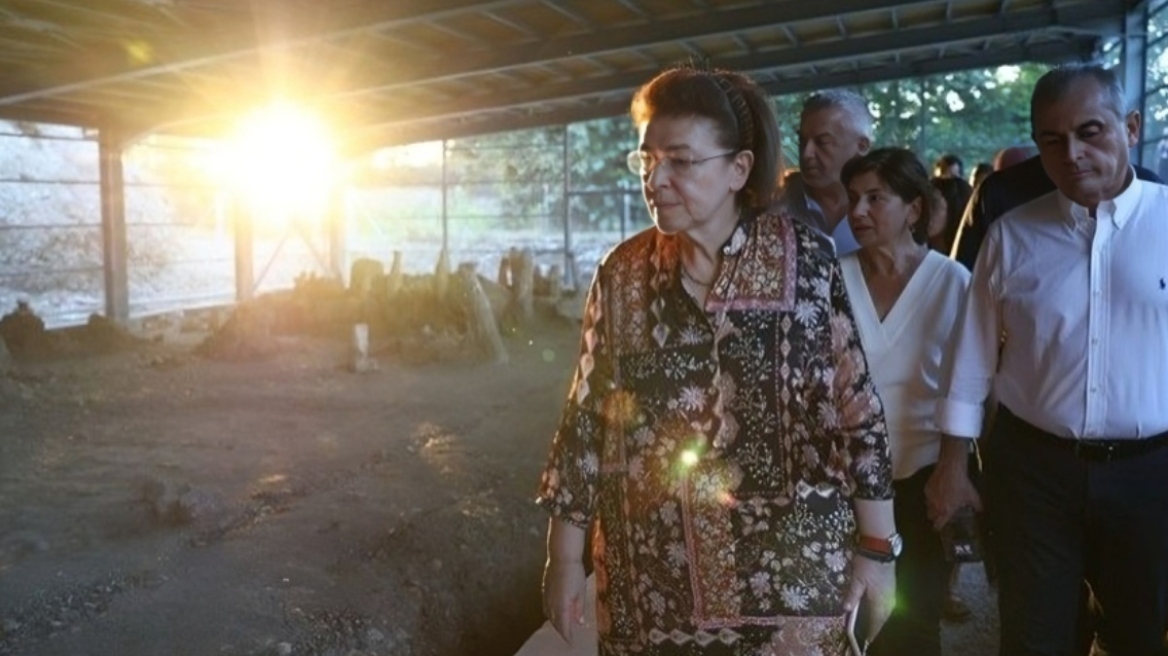
Mendoni said total investment in the Serres regional unit over the past seven years now exceeds 25 million euros, with close to 20 million euros directed at the Kasta tumulus alone. She said the scale of the work reflected the Kyriakos Mitsotakis government's commitment to a unique Macedonian monument first uncovered in 2014, which is being studied in cooperation with Greek and foreign specialists.
The tumulus remains on schedule to open to visitors in early 2028, she added, barring new scientific complications that might require a short extension.
During a separate inspection on Saturday afternoon, Mendoni said restoration work inside the burial monument was advancing at a satisfying pace. She noted that a major challenge had been met: the marble door at the tomb's entrance had been reassembled and repositioned successfully. The contractor responsible for building the museum space, which will house both a digital and a conventional exhibition about the monument, is expected to begin work in the first two weeks of September.
Mendoni said the monument continues to pose dilemmas requiring scientific solutions, and that the goal is for its restoration to serve as a model not only by Greek standards but by international ones as well.
A bridge that connected two worlds
The ancient wooden bridge at the centre of the ceremony is roughly 2,500 years old, built over the Strymon river in front of Gate III of the city's northern wall. It was discovered during excavations by Dimitris Lazaridis between 1976 and 1978. A total of 1,250 wooden stakes and tree trunks were found, of which 220 were recovered from the riverbed. It is the only surviving ancient wooden bridge in Greece.
Thucydides mentioned the bridge in his account of events between 424 and 422 BC, when the Spartan general Brasidas crossed it to seize Amphipolis, exploiting the city's strategic position on the Strymon. That seizure was a pivotal moment of the Peloponnesian War.
Interdisciplinary analysis of the remains identified six distinct construction phases, from the 8th to 6th centuries BC through to the 16th and 17th centuries AD, a continuous span of roughly 2,500 years that makes the bridge one of the rarest surviving examples of ancient bridge-building in the world.
Mendoni said Amphipolis had been an important city across its entire long history, especially from the late archaic period onwards. She said it was no coincidence that Alexander the Great chose that place, that river and that sea to launch his eastern campaign. The wooden bridge, she added, had united the two banks of the Strymon and, in a sense, had linked West with East until the 19th century.
A digital passage through time
Visitors can now cross the ancient bridge virtually through a project called the Digital Passage at Amphipolis. An 80 square metre exhibition cabin, operating under the name The Bridge: Archaeological Information Spot, houses multimedia displays, interactive maps, educational games and virtual reality applications. The structure is a minimalist metal construction raised 20 centimetres above ground level, with glass facades that preserve direct sightlines to the archaeological site itself.
The digital reconstruction project cost 1.2 million euros, funded entirely from the Recovery Fund, and was carried out by the Ministry of Culture's Restoration Directorate and the Serres Antiquities Ephorate.
Dimitria Malamidou, head of the Serres Antiquities Ephorate, described the project as emblematic and said the combination of the new modern roof structure and digital applications gave the archaeological information about Amphipolis a new contemporary dimension. Amphipolis mayor Stergios Frastanlis thanked the minister for her sustained personal interest, which he said her repeated site visits demonstrated. Serres deputy regional governor Panagiotis Spyropoulos also praised the ministry's work and Mendoni's personal involvement.
Mendoni closed by saying the Ministry of Culture, the Greek government and the Greek state have a duty to deliver this treasure to the local community in the best possible way, and that the local community, through its representatives and institutions, must then manage it accordingly.


