

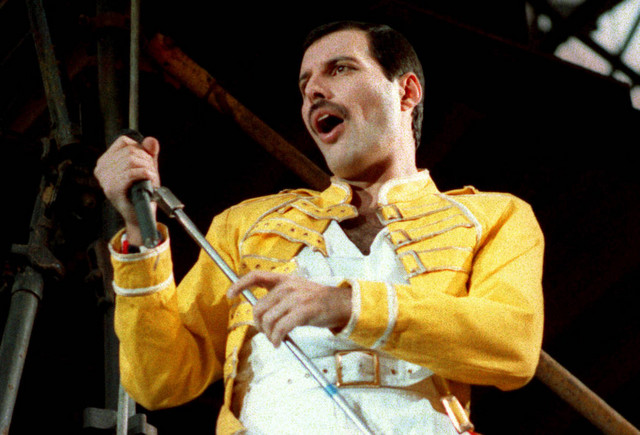
Farrokh Bulsara, who the world would come to know as Freddie Mercury, was born in Zanzibar on September 5, 1946. Eighty years after his birth, he remains one of the defining models of the rock frontman, and not for a single reason.
Bulsara grew up partly in India and moved to England with his family in 1964. A few years later he met Brian May and Roger Taylor, and it was Mercury who proposed the name Queen for the band they went on to form.
The Songs
Stage presence and elaborate costumes caught the eye first, but the songs were the foundation. Mercury wrote several of Queen's biggest hits, including "Bohemian Rhapsody," "Killer Queen," "Somebody to Love," "We Are the Champions," "Don't Stop Me Now" and "Crazy Little Thing Called Love." He could move from pop to opera, from gospel to hard rock, and from a personal ballad to a song built for an entire stadium to sing. Queen did not depend on one songwriter; May, Taylor and bassist John Deacon also wrote major hits. But Mercury had the ability to make almost anything sound like Queen.
The Voice
It has long been repeated that Mercury's voice spanned four octaves. A scientific analysis of his recordings found just over three octaves, not confirming the famous claim. That detail matters little. What was genuinely unusual was the power behind his singing, his distinctive vibrato, and above all his ability to shift character from one song to the next. From "Somebody to Love" to "Bohemian Rhapsody" to "Who Wants to Live Forever," his voice was almost impossible to mistake for anyone else's.
Live Aid and the Final Shows
If one moment explains the Mercury legend, it is Queen's 21 minutes at Live Aid on July 13, 1985. At Wembley Stadium, in front of tens of thousands of people, he needed nothing more than a piano, a microphone and the crowd. The famous "Ay-Oh" exchange, with the entire stadium echoing his vocal calls, has remained one of the most recognizable moments in the history of live performance. A year later, Queen played Knebworth. Nobody knew it at the time, but it would be their last concert with Mercury.
Image and Excess
In the 1970s, at the height of glam rock, few performers could match Mercury for theatricality. Full-body suits, plunging necklines, winged sleeves, satin, fur and costumes designed by people such as Zandra Rhodes all became part of the show. In the 1980s his look changed again: short hair, a white vest, jeans and his famous mustache. In the video for "I Want to Break Free," he appeared in a mini skirt, tights and heels, without giving up the mustache. He did not try to fit the traditional image of a rock star. He built his own. His public image off stage was just as excessive, marked by parties, nightlife and stories that over the years passed from biography into legend, some documented and others not, all of them fitting a man who had made excess part of his persona.
Musicianship
Behind the showman was a serious musician. He learned piano as a child, and the instrument became central to writing songs such as "Bohemian Rhapsody," "Somebody to Love" and "Don't Stop Me Now." Queen could move between hard rock, pop, disco, funk, rockabilly and near-operatic harmony without seeming to lose their identity, and much of that flexibility came down to Mercury. He could sound aggressive, playful, dramatic or vulnerable, and convincing in every mode.
The Mustache
No look back at Freddie Mercury is complete without it. The thick chevron mustache he adopted in the early 1980s became so recognizable that it functions almost like a logo. A white vest, half a microphone stand, a raised fist and that mustache: the image alone is enough.
Mercury died on November 24, 1991, at the age of 45, from bronchopneumonia linked to AIDS. He had publicly announced only a day earlier that he had the disease. He lived less than half a century but had enough time to create one of the most recognizable personas in the history of music. The songs, the voice, the theatrics, the musicianship, the excess and the ability to hold an entire stadium in his hand were the ingredients. The result was called Freddie Mercury.
Other Events on September 5
The date carries other historical weight. In 1905, the Russo-Japanese War ended with the Treaty of Portsmouth, a victory that marked Japan's emergence as a major military and political power. In 1929, French Prime Minister Aristide Briand proposed a federal union of European states to the League of Nations, an idea later seen as a forerunner of European integration. In 1944, German occupying forces executed 50 Greek resistance fighters at the Kaisariani shooting range, among them 17-year-old Iro Konstantopoulou, a member of the EPON youth resistance organization who had been tortured without revealing her comrades.
In 1960, 18-year-old Cassius Clay, later known as Muhammad Ali, won Olympic boxing gold in Rome. In 1967, Yiannis Chalkidis, an official of the Lambrakis Democratic Youth in Thessaloniki, was killed by forces of the Greek military junta. In 1972, the Munich massacre struck the Olympic Games when members of the Palestinian group Black September attacked the Israeli delegation, leaving 11 Israelis, five attackers and one West German police officer dead. In 1997, International Olympic Committee president Juan Antonio Samaranch announced in Lausanne that Athens would host the 2004 Olympic Games. In 2002, Dimitris Koufontinas, known as "Loukas" of the November 17 group, surrendered to Greek anti-terrorism police and said he was taking political responsibility for the organization's actions.
The day also marks the births of American outlaw Jesse James in 1847, Greek journalist and writer Freddy Germanos in 1934, and American actor Michael Keaton in 1951, known for playing Batman in Tim Burton's films. Mother Teresa, the Catholic missionary and Nobel Peace Prize laureate, died on this date in 1997.


