

An international team of astronomers has analyzed 129 nearby galaxies for signs of hypothetical alien Dyson swarms and detected no evidence of technological waste heat.
The comprehensive survey, published on the arXiv preprint server, represents the largest search to date for galaxy-scale extraterrestrial energy harvesting structures. Researchers used advanced models of stellar population synthesis to inspect galaxy spectra, finding that no galaxy in the sample required a technological component to explain its light output.
A Dyson sphere is a hypothetical megastructure first proposed by physicist Freeman Dyson in 1960. The concept suggests that an advanced technological civilization might enclose stars with energy collectors to capture their output. While a solid shell is physically impractical, a dense swarm of orbiting satellites, solar collectors, and habitats could achieve the same result.
Physics of galactic Dyson swarms
The search strategy relies on fundamental thermodynamic principles. When energy collectors intercept starlight to power a civilization, that energy cannot disappear. Once consumed, it must ultimately radiate back into space as lower-energy infrared waste heat.
Astronomers can detect these structures by looking for excess infrared radiation that standard astrophysical processes cannot explain. The study defines a hypothetical megastructure complex as a Dyson swarm, using the parameter alpha to represent the exact fraction of starlight intercepted by the solar arrays.
Synthetic testing and detection limits
To validate their detection methodology, the team tested how reliably their models could identify artificial signals hidden within astronomical data. They created 1,419 simulated spectral energy distributions by adding computer-generated Dyson swarms with varying alpha values to actual galaxy observations.
The statistical models recovered the artificial signals with high accuracy, yielding a linear dependence slope of 0.92 between the actual and reconstructed fractions. In calm, quiescent galaxies with low rates of star formation and minimal interstellar dust, the technique successfully isolated swarms intercepting as little as 4% to 5% of total stellar light.
Observations of galaxy M77
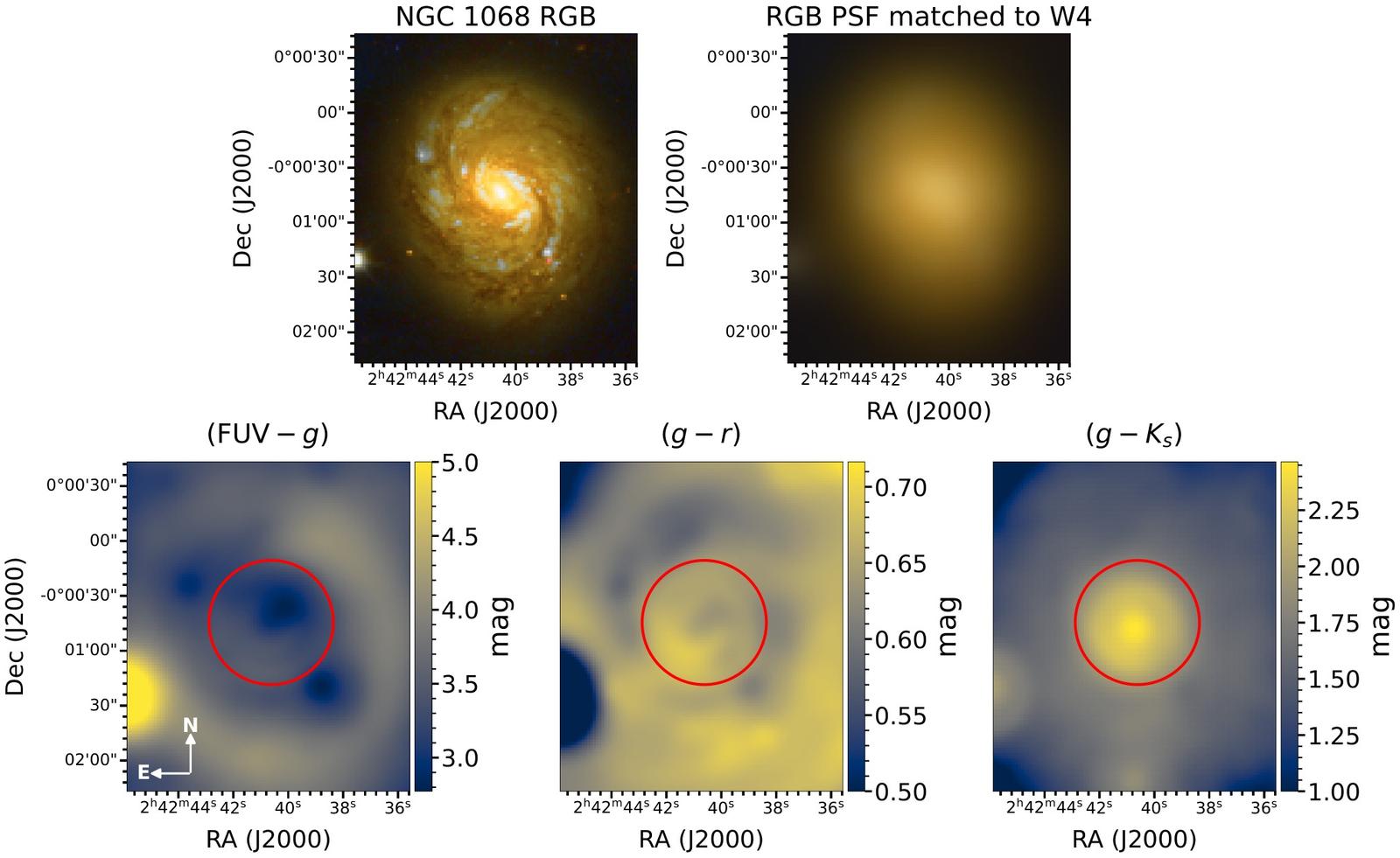
The researchers applied their spatially resolved modeling techniques to galaxy M77, which is also designated as NGC 1068. They combined optical images from the Sloan Digital Sky Survey across the r, g, and u filters with infrared observations matched to the angular resolution of the WISE W4 channel.
At original optical resolutions, M77 clearly displays a central spiral bar, active star-forming arms, and a foreground star to the southeast. When degraded to the broader resolution of the WISE W4 instrument, the galaxy collapses into a smoothed, center-concentrated ellipsoidal profile spanning only a few resolution elements.
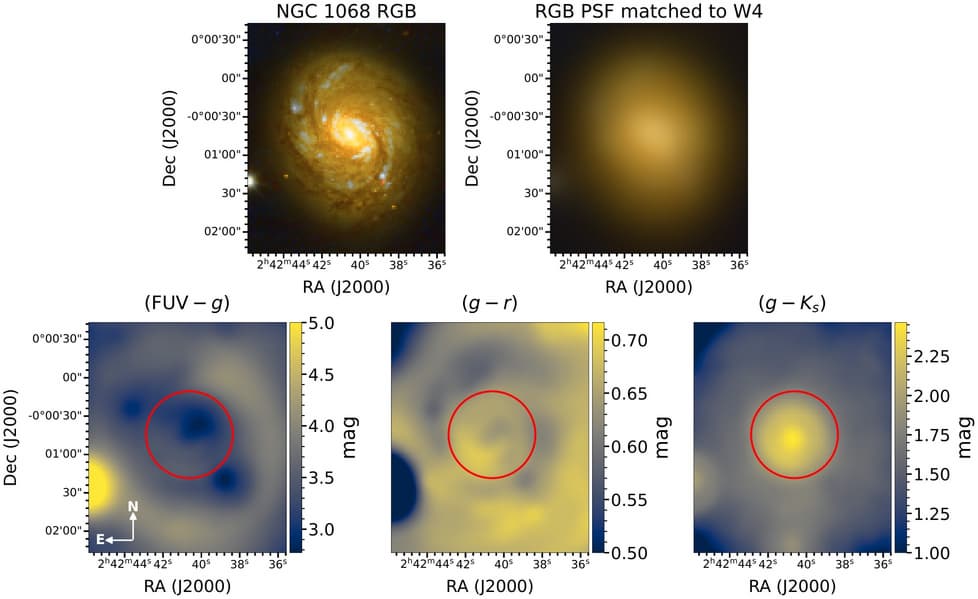
To evaluate the galaxy, the authors constructed FUV-g, g-r, and g-Ks color maps in the AB photometric system. They defined a red exclusion circle with a radius of 34 arcseconds around the galaxy center to separate nuclear radiation from disk emission.
The map analysis revealed a uniform g-r color distribution across the disk alongside a smooth g-Ks gradient from older stars. Inside the central 34-arcsecond region, a sharp radiation excess appeared in the Ks band due to dust heated by the active galactic nucleus. The nucleus appeared blue in FUV-g and red in g-Ks, a pattern characteristic of an active nucleus surrounded by star formation rather than a Dyson swarm, which would attenuate ultraviolet light where waste heat rises.
Interference from dust and active nuclei
Quiescent galaxies proved to be the most reliable targets for technosignature searches. Infrared emission in these systems stems from well-understood sources, such as dust surrounding aging stars, making artificial heat signatures easier to distinguish.
Star-forming galaxies present greater challenges because warm interstellar dust naturally generates an infrared excess. In active star-forming systems, a Dyson swarm would need to intercept approximately 20% of total starlight to stand out against natural dust emission. Active galactic nuclei also produce hot dust emissions that can easily mimic the thermal signature of alien technology.
Observational results across 129 galaxies
When applied to observational data from all 129 galaxies, the models found no statistically significant evidence supporting the presence of Dyson swarms. None of the galaxies required an artificial infrared component to fit the observed light profiles.
For quiescent galaxies lacking a dominant active nucleus, the median upper limit on intercepted starlight was measured at just 0.3%. Across the full galaxy sample, the lack of detections indicates with 95% statistical confidence that no more than 2.6% of galaxies host swarms capturing 25% or more of their stars' light output.
Future search strategies and space telescopes
The study outlines clear methods to differentiate genuine technosignatures from natural astrophysical phenomena. Spatial structure provides a key diagnostic, as galactic Dyson swarms would spread across the stellar disk, whereas active nuclei cluster at the core and star-forming dust traces spiral arms.
Researchers proposed using specific mid-infrared and far-infrared spectral analyses to confirm future candidates. Upcoming wide-field observations from the PRIMA mission will help characterize cold spectral components, while detailed follow-up observations can be conducted using the James Webb Space Telescope.
Although the search yielded no alien civilizations, the study establishes a scalable framework that can analyze millions of galaxies using existing multi-wavelength surveys. The research was conducted by Olivia Curtis, Aidan J. Rowland, Jason T. Wright, Caryl Gronwall, Jakob M. Helton, and Joel Leja.


