The father of Pinocchio turned 200 years old this week. Not Geppetto, the carpenter in the story, but Carlo Collodi, the Italian writer who created him and gave the world one of the most universal figures in children's literature, a character originally conceived not as the gentle tale popularized by Walt Disney, but as a raw portrait of social injustice, poverty and the living conditions of children in rural 19th century Italy.
Collodi was born Carlo Lorenzini in Florence on November 24, 1826. He adopted the pen name Collodi in honor of the small Tuscan village where his mother's family came from and where he spent long stretches of his childhood.
Collodi fought for Italian unification during the Risorgimento, the 19th century movement that led to Italy becoming a single nation, and also worked as a theater and music critic, a humorist and a columnist. Roberto Vezzani, librarian at the Carlo Collodi National Foundation, told the EFE news agency that he was, in every sense, a major 19th century Italian intellectual.
Two centuries after his birth, the village that gave the writer his name remains tightly bound to his most famous creation. Along its narrow, steep streets, typical of a small mountain town where life moves at the slow pace of its bars, post office and the odd pizzeria, the famous puppet turns up everywhere, in statues, signs, shop windows and wordplay scattered around every corner.
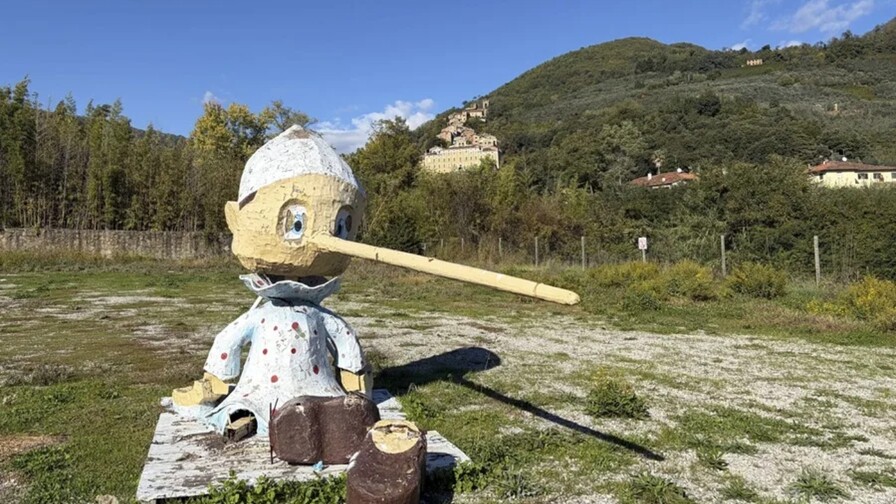
The village also houses the archive of the foundation that bears the writer's name, which keeps hundreds of editions of "Pinocchio" in different languages and dialects, along with documents and works from his literary and journalistic career.
The original, darker story of Pinocchio
Far from the softened version Walt Disney brought to the big screen in 1940, the original story began appearing in installments in 1881 in the pages of the newspaper "Giornale per i bambini," under the title "La storia di un burattino," or "The Story of a Puppet."
That Pinocchio lived in a far harsher world, marked by poverty, inequality and a justice system that did not always protect the most vulnerable. Daniele Rossi, secretary of the Carlo Collodi National Foundation, told EFE that the story reflected a culture, a peasant, rural Tuscan civilization, with all its injustices. He described the book as an allegorical representation of the social reality Collodi lived in.
Children's lives reflected in the tale
One of the most revealing aspects of the story is the place of children in that society. Rossi said that in a rural civilization, children were put to work, so when Pinocchio finally grows feet and tries to run away, he is also representing how children were treated at the time. He called it a cruder version of events, but also a truer one in some respects.
In Collodi's original plans, the story was meant to end tragically, with the wooden puppet hanged from a branch of the Great Oak. Only pressure from readers persuaded him to spare the character and continue the plot, which went on to become a worldwide publishing phenomenon, with close to 700 translations into more than 200 languages and dialects.
Pinocchio Park marks its 70th anniversary
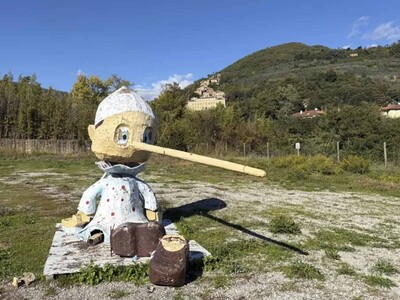
In Collodi, the character has his own dedicated space: the Pinocchio Park, which is marking its 70th anniversary this year. Despite the name, it is not a conventional amusement park. Surrounded by trees, small streams and vegetation, the site offers an outdoor route through some of the book's most famous episodes, recreated through bronze sculptures, mosaics and various art installations.
The project began in the 1950s, when the then-mayor of Pescia, the municipality to which Collodi belongs, pushed for a monument to be built in the writer's memory. The initiative gradually grew into today's park, which is run by the Carlo Collodi National Foundation and is presided over nearby by a huge 19-meter-tall sculpture of the famous puppet.
In this anniversary year, the foundation wants to restore Pinocchio's centrality and remind people that the international icon is not disconnected from its place of origin. Rossi said that, beyond being profoundly Italian, the character is profoundly Tuscan and, above all, profoundly from Collodi.
Test yourself
Why did Carlo Lorenzini adopt the pen name Collodi?
How was the original ending of Pinocchio meant to conclude?
About how many languages and dialects has Pinocchio been translated into?
Have your say
Which version of Pinocchio do you prefer?
Where it happened
Collodi, Italy