

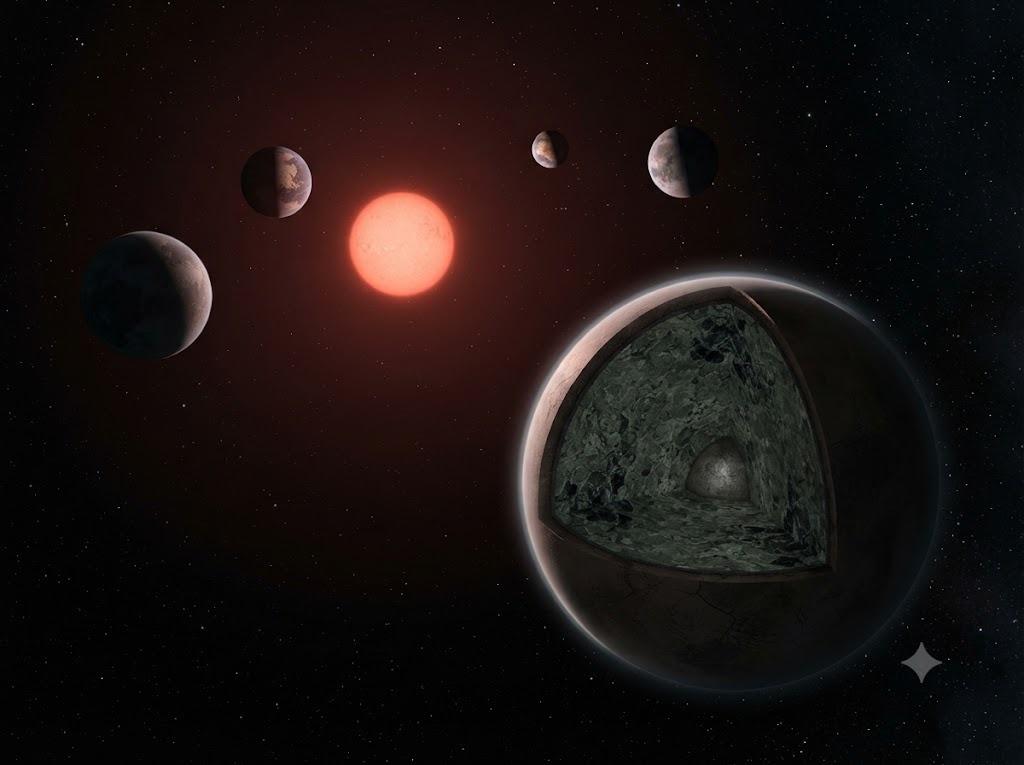
Astronomers at the Institute of Astronomy at Cambridge University concluded that all four exoplanets orbiting Barnard's Star lost their atmospheres billions of years ago. According to modeling published in the Monthly Notices of the Royal Astronomical Society, the primary hydrogen-helium envelopes of the planets were completely destroyed no later than 2 billion years after formation. Conditions for secondary atmospheres to appear today look extremely unfavorable.
Researchers investigated several aspects of the system, including orbital stability, internal planet structure, mantle water content and atmospheric evolution. All four exoplanets are classified as sub-Earths, which are rocky planets lighter than Earth. They orbit the red dwarf star, the closest single star to the Sun, in 2.34 to 6.74 days. Because they are located closer to their star than Mercury is to the Sun, they face constant exposure to powerful X-ray and extreme ultraviolet radiation.
Calculations showed that this radiation rapidly destroyed their original atmospheres. The process took about 10 million years for the inner planets and roughly 100 million years for the outer ones. Models indicate that no atmosphere could survive longer than 2 billion years even under varying initial mass estimates, whereas Barnard's Star itself is estimated to be between 7 and 12 billion years old.
The image was generated by Nano Banana.
Internal Structure and Water Capacity
Researchers also evaluated the internal structure of the planets by reconstructing their interior composition from the chemical signature of the star. Their findings indicate that the mantles contain large amounts of ferropericlase, a mineral that holds significantly less water than the primary minerals in Earth's mantle. As a result, the total water capacity of their mantles is less than half that of Earth, with the largest planet holding about 1.52 Earth ocean volumes of water compared to nearly 3 Earth ocean volumes in a similar model of Earth.
This water deficiency combines with weaker internal heating. Current radiogenic heat production is calculated at approximately 12 ± 3 picowatts per kilogram of magnesium, which is roughly half of Earth's rate of about 24 picowatts per kilogram. This lower heat output means less active volcanism and significantly smaller volumes of gas to replenish lost atmospheres. However, researchers noted that possible tidal heating from orbital resonances cannot yet be confirmed or ruled out.
Future Telescopic Observations
The conclusions are based exclusively on modeling rather than direct physical observations and must still be verified through spectral measurements. Astronomers plan to use instruments on the European Extremely Large Telescope (ELT), primarily the ANDES spectrograph, to search for atmospheric signatures on the nearest rocky exoplanets. Additional data is expected from the PLATO space mission, which is designed to search for and study small planets around nearby stars.


