


A sequence of four fossilized footprints discovered in North Dakota represents the first known trackway of an adult Tyrannosaurus rex walking across the landscape.
The 66.5-million-year-old trackway, uncovered in the Hell Creek Formation near the city of Marmarth, spans roughly seven meters. The sequence consists of two left and two right footprints, each measuring approximately 0.9 meters in length, according to a study published in the Journal of Vertebrate Paleontology.
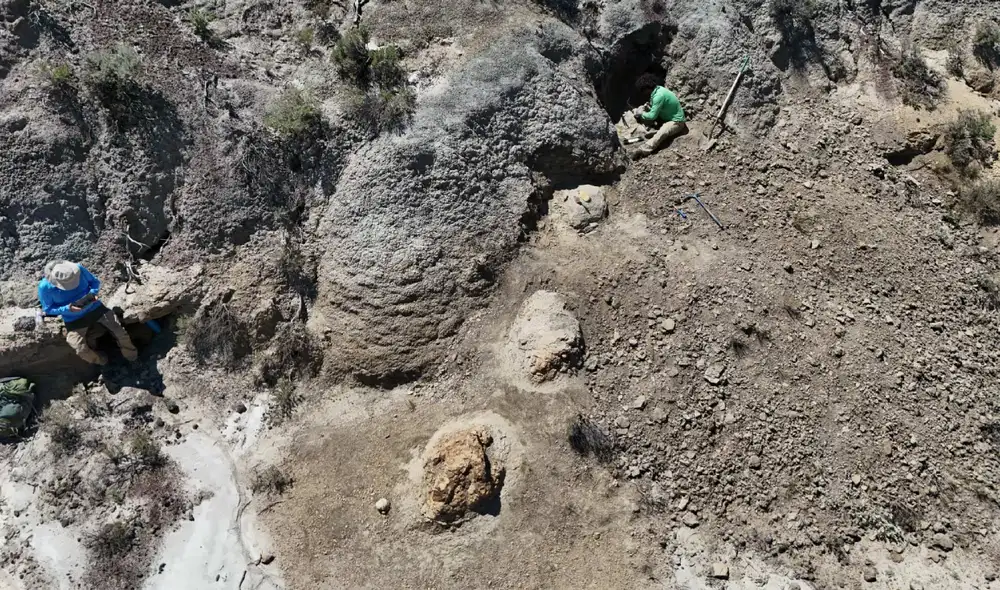
The distance between the three-toed footprints, known as the stride, measures about four meters. Using this data, scientists calculated that the massive dinosaur was moving at a speed of between 5.6 and 7.2 kilometres per hour. This pace is roughly equivalent to a brisk walk for a human.
Researchers noted, however, that the speed estimate remains approximate because the highly eroded and fractured state of the footprints limits the precision of the calculation.
Trace fossils capture dinosaur behaviour
In paleontology, footprints and trackways are known as trace fossils. Unlike body fossils such as bones or teeth, which reveal an animal's anatomy, trace fossils provide direct evidence of an extinct creature's behaviour, locomotion, and interaction with its environment in real time.
While isolated footprints attributed to tyrannosaurs have been identified previously, finding several consecutive footprints from large theropods is highly uncommon in the Hell Creek Formation. The trackway, initially discovered in 2025, is the first sequence that allows researchers to trace the continuous movement of an adult specimen.
Tyler Lyson, the principal curator of vertebrate paleontology at the Denver Museum of Nature & Science, said that while bones provide extensive information about the animals, footprints uniquely capture a specific moment of their behaviour. The ability to follow a Tyrannosaurus rex as it moved through its environment is incredibly rare, he added.

Identifying the apex predator
The tracks themselves lack detailed anatomical features, but they clearly show the animal's immense size and three toes. Researchers concluded a Tyrannosaurus rex most likely made the prints due to their enormous scale, the narrow shape of the toe marks, and the specific angle between the toes. The abundance of Tyrannosaurus rex fossils found in the surrounding rocks further supported the identification.
The Tyrannosaurus rex was one of the largest apex predators to ever walk the Earth. A bipedal carnivore with a massive skull balanced by a long, heavy tail, it dominated the North American landscape during the Late Cretaceous period, shortly before the asteroid impact that caused the mass extinction of non-avian dinosaurs 66 million years ago.
Geological preservation and digital analysis
The dinosaur originally left its tracks in muddy sediment. Over time, those depressions became surrounded by sandstone that was cemented together with calcium carbonate. Over millions of years, erosion wore away the softer surrounding rock, finally exposing the hardened casts of the footprints.
To document the remote site, the research team used high-resolution three-dimensional scanners to create digital models of each print. This technology allowed researchers to examine the trackway in intricate detail and produce physical replicas of the fossils.
Peter Falkingham, a professor of paleobiology at Liverpool John Moores University and the lead author of the study, directed the research without visiting the site. He said the digital scanning technology allowed his colleagues to send the three-dimensional information from the field, enabling him to view the trackway on his computer and in virtual reality almost as if he were examining it in person.
Moving the trackway to Denver
The Hell Creek Formation, where the discovery was made, is a heavily studied geological formation spanning parts of Montana, Wyoming, North Dakota, and South Dakota. It is renowned worldwide for its rich deposits of Late Cretaceous fossils, offering a detailed look at the ecosystem right before the extinction event.
The research team plans to use a helicopter this autumn to recover three of the four footprints from the rugged terrain and transport them to the Denver Museum of Nature & Science. The museum expects to share updates on the recovery effort with its visitors during the winter.


