
Peru's Prime Minister Luis Galarreta announced that the Ministry of Economy and Finance will review tax exemptions for agricultural exporters, as a congressional bill moves to remove benefits for large companies.
The legislative proposal presented in Peru's Congress by Deputy Analí Marquez seeks to exclude large agricultural enterprises with annual net revenues exceeding 2,300 Tax Units from the preferential tax regime under Law 32434. The initiative calculates that withdrawing these concessions could generate up to 1.7558 billion Peruvian soles (S/1.7558 billion) in additional annual revenue for the state.
In Peru, fiscal thresholds are determined using the Tax Unit (UIT), an official reference value set annually by the government for administrative and tax calculations. The Ministry of Economy and Finance (MEF) oversees the country's fiscal policy and revenue collection.
Speaking in an interview with radio broadcaster RPP, Prime Minister Galarreta stated that Economy Minister Elmer Cuba will conduct a comprehensive technical evaluation of existing tax incentives. Galarreta noted that the government would evaluate everything when asked about tax exemptions across various sectors.
The Prime Minister explicitly cited the agricultural export industry as a key target for scrutiny. He said he believed the economy minister would evaluate the sector to determine whether it was appropriate to maintain the current benefits, reduce them, or establish a new strategy.
The Executive branch has not yet decided which specific tax breaks will be altered or eliminated. Galarreta emphasized that any final determination must arise from the technical review by the MEF regarding the cost and policy objectives of each incentive.

Proposed Limits for Large Agribusinesses
While the Executive evaluates options, the measure introduced by Deputy Marquez outlines specific restrictions to remove large scale operations from the preferential agrarian tax framework. The proposal defines a large agricultural business as one generating annual net income above 2,300 UIT.
Under the proposed legislation, these high earning companies would no longer qualify for the preferential benefits established by Law 32434. The bill argues that tax incentives should focus on supporting small agricultural producers rather than continuing to benefit well established firms with consolidated market positions.
Tax Rate Differences and Revenue Impact
Law 32434 currently grants qualifying agricultural companies a reduced Income Tax rate of 15 percent between 2026 and 2035. In contrast, businesses operating under Peru's general tax regime pay a standard Income Tax rate of 29.5 percent. The agricultural regime also includes special provisions for advance tax payments and other tax mechanisms.
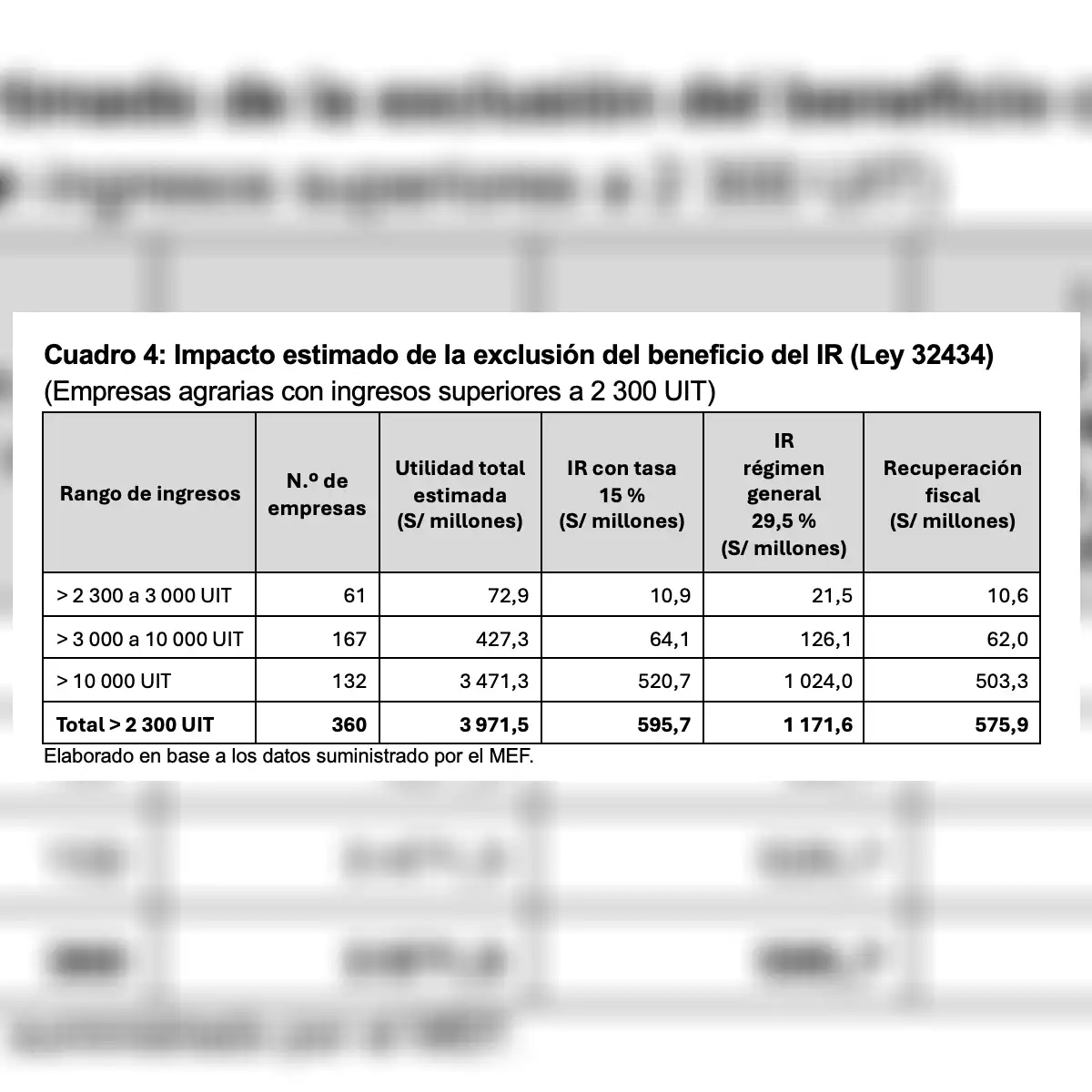
The financial impact of excluding major firms from the reduced rate is substantial. According to calculations included in the legislative proposal, 360 large companies that would be excluded from the benefit hold an estimated total profit of S/3.9715 billion.
At the preferential 15 percent rate, these 360 companies would pay approximately S/595.7 million in Income Tax. If subjected to the general rate of 29.5 percent, their tax payments would rise to S/1.1716 billion, generating an additional S/575.9 million in annual revenue for the public treasury from the rate adjustment alone.
The bill's authors estimate that the total suite of tax concessions provided under Law 32434 represents an annual fiscal cost of S/1.8882 billion between 2025 and 2035. By ending these perks for large corporations, the legislative proposal estimates the state could recover up to S/1.7558 billion annually. The document notes that this estimate reflects the proposal's own calculations rather than an official MEF projection.
Concentration of Tax Benefits and Economic Expansion
To justify the reform, the legislative proposal points to historical data from the Ministry of Economy and Finance under previous legislation. Official figures cited in the project reveal that 506 taxpayers with annual incomes exceeding 1,700 UIT captured 92 percent of all tax benefits granted under Law 31110, the predecessor to the current agricultural framework. The authors contend this concentration demonstrates that incentives designed to promote sector growth have disproportionately favored the largest market players.
The review announced by the government aligns with previous warnings raised by fiscal authorities. During past debates over agricultural tax breaks, the MEF expressed concern regarding their impact on public accounts and questioned why a significant portion of the incentives ended up concentrated among major corporations.
The tax debate arrives as Peru's agricultural export industry reflects dramatic expansion over the past decade. Ministry data highlights that total agricultural exports grew from US$5.107 billion in 2015 to US$14.522 billion in 2025, while non-traditional agricultural shipments alone reached US$12.610 billion.
This rapid commercial growth has fueled conflicting views on tax policy. Industry defenders argue that ongoing tax incentives are vital to attract private investment, generate rural employment, and maintain international competitiveness. Conversely, proponents of reform argue that after a decade of strong expansion, consolidated corporate producers no longer require state tax assistance.
Beyond the agricultural export sector, Prime Minister Galarreta instructed Economy Minister Cuba to evaluate tax exemptions and incentives across other industries. The administration aims to determine which tax privileges maintain economic justification and which should be modified or rescinded.